

Pull handles aren’t automatically the better choice. Knobs suit standard cabinet doors and create a quieter look, while pulls offer a broader grip and are often more practical on heavy doors, wide drawers and integrated appliances. To decide how to choose kitchen cabinet handles, consider how each cupboard opens, then compare the handle’s size with the door or drawer.
It’s easy to focus on the finish or shape first, but a handle needs to feel comfortable and look in proportion as well as complement your kitchen. The right choice depends on how you use the space and the style you want to create.
This guide explains when to choose knobs or pulls, how to approach finishes without needing every metal detail to match, and which styles and sizes to consider. You’ll also find a simple way to picture a pull on your cabinetry before settling on its proportions.
Key Takeaways
- Choose between knobs and pulls by considering how you use each cupboard, not just the look you prefer.
- Coordinate handle finishes with the kitchen’s other details, while allowing different metals to sit comfortably together.
- Match handle style to your cabinetry, then consider how the shape feels in everyday use.
- Check a pull’s scale against the drawer or door before settling on a size.
1. Should you choose cabinet knobs or pull handles?
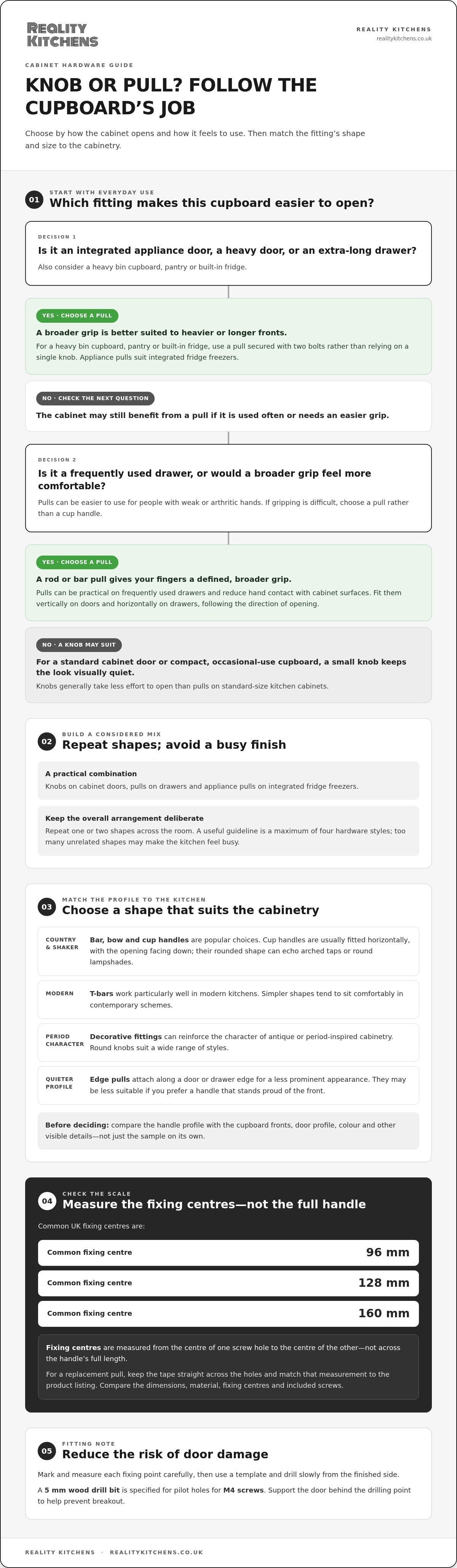
Kitchen cabinet fittings include knobs, bar pulls, bow pulls, cup handles, T-bars and edge pulls. Knobs suit a simple, understated look, while pulls provide a broader grip and can be easier to use for people with weak or arthritic hands. Choose according to the cabinet’s use as well as its appearance: a pull can feel more practical on a frequently used drawer, while a small knob can keep a compact door visually quiet.
For country kitchens and Shaker-style units, bar, bow and cup handles are popular choices. Cup handles can echo rounded details such as arched taps or round lampshades; they’re usually fitted horizontally, with the opening facing down. T-bars work particularly well in modern kitchens, while round knobs suit a wide range of styles. On antique or period-inspired cabinetry, decorative fittings can reinforce the character; simpler shapes tend to sit more comfortably in contemporary schemes. Consider the door profile, colour and other visible details together before choosing.
Keep the overall arrangement deliberate. A kitchen can combine different fittings, such as knobs on doors and pulls on drawers, but too many unrelated shapes may make the room feel busy. A useful guideline is to limit the room to a maximum of four hardware styles. Repeat shapes or finishes across the cabinetry to tie the design together.
UK handle prices vary with material, finish, style and quantity; a price is given after a quote request. In product listings, compare the handle’s dimensions, fixing centres, material and included screws so you can assess suitability before ordering. Handles are commonly bought through kitchen and hardware retailers, including online sellers.
To reduce the risk of damaging a cabinet door, mark and measure each fixing point carefully, then use a template and drill slowly from the finished side. A 5mm wood drill bit is specified for pilot holes for M4 screws; support the door behind the drilling point to help prevent breakout.
2. Do my handle finishes need to match my other appliances?
No. Your handles don’t have to match every appliance, but a deliberate relationship between finishes helps the room feel cohesive. Start by identifying the dominant metals, such as stainless steel on an oven and tap, then decide whether handles should repeat that finish or provide contrast. Repeating one finish across handles, taps and architectural details creates a considered look; carefully chosen differences can feel beautifully layered.
Mixing metals works best when you set a clear limit. Keep the kitchen’s hardware palette to a maximum of three metal finishes, then repeat each finish somewhere else. For example, brushed brass handles could sit alongside stainless steel appliances and a darker tap, with those metals echoed in lighting or other details. Brushed finishes soften reflections, while polished surfaces can show fingerprints readily. Matte finishes offer a quieter appearance, while antique-style hardware can suit a more traditional scheme.
Material and surface treatment affect how handles look over time. Unlacquered, or living, brass develops a patina in response to its surroundings and daily use, so its appearance changes. Lacquered brass has a clear coating that protects the surface from oxidising in the air. Plated hardware has a thin layer of metal, such as chrome or nickel, electroplated onto solid brass. Solid brass and stainless steel are durable, long-lasting handle materials.
Choose a finish with everyday use in mind, not just its sample appearance. Compare the handle beside your appliance, tap and worktop under the kitchen’s lighting; check the colour in both daylight and artificial light. Then repeat your preferred finish in another fitting, allowing different metals to remain intentional rather than scattered. If you’re planning cabinetry, appliances and worktops together, bespoke kitchen design can help bring those decisions into one coherent scheme.
3. Knobs, hooded pulls, rod pulls and edge pulls
Handle shape changes both the cabinet’s character and how you use it. A classic knob creates a compact finishing touch on a cabinet door, while a hooded pull has a curved grip that sits over its fixing points. Rod pulls have a straight, bar-like form; edge pulls attach along a door or drawer edge for a quieter, less prominent appearance. Compare each profile with the cupboard fronts, rather than choosing from a sample alone.
Function matters as much as appearance. Knobs generally take less effort to open than pulls on standard-size kitchen cabinets, while pulls can reduce hand contact with cabinet surfaces. If gripping is difficult, choose a pull rather than a cup handle. A rod pull gives your fingers a defined grip; an edge pull may be less suitable if you prefer a handle that stands proud of the front.
Mixing fittings can make a kitchen more practical without making every cupboard identical. A common arrangement uses knobs on cabinet doors, pulls on drawers and appliance pulls on integrated fridge freezers. Position pulls vertically on doors and horizontally on drawers, following the direction of opening. For a heavy bin cupboard, pantry or built-in fridge, use a pull secured with two bolts rather than relying on a single knob.
Consider the door’s weight and how often you open it. Pulls are better suited to integrated appliance doors, extra-long drawers and heavier soft-close doors than knobs. A small knob can work on an occasional-use cupboard, while a longer pull offers a more secure grip on a frequently used drawer. To keep the overall look cohesive, repeat one or two shapes across the room, then let a distinctive hooded or edge pull add character where it serves a clear purpose.
4. Choosing handle size
Handle size affects both the cabinet’s aesthetic and the comfort of daily use. In the UK, common fixing centres are 96mm, 128mm and 160mm. Fixing centres measure the distance between the centres of the screw holes, not the handle’s full length.
For replacement pull handles, measure from the centre of one fixing hole to the centre of the other. Keep the tape straight across the holes, then match that measurement to the product listing. Handles with 96mm centres typically measure 120–140mm overall; 128mm centres usually mean 150–180mm overall. A 160mm-centre handle is typically 190–220mm long.
For new handles, compare the pull length with the drawer front and allow enough room for four fingers to grip comfortably. A practical guide is to use pulls 80–100mm long on drawers up to 300mm wide, and 120–200mm pulls on drawers from 300–750mm wide. Drawers wider than 750mm are classed as large; the same 120–200mm pull range is suggested.
Knobs offer another proportion option: choose a 20–30mm diameter for drawers up to 300mm wide, or 30–40mm for drawers from 300–750mm wide. For drawers wider than 600mm, two handles can create balanced access; narrower drawers generally suit one handle or knob. Consider the door or drawer’s surface and the surrounding contemporary fittings before choosing a statement size.
To judge the scale before buying, cut masking tape to the pull’s full length and place it horizontally on the drawer, then vertically on a door. Step back and compare its proportions with neighbouring fronts. Medium or large pulls are common on large fridge doors; undercounter fridges usually suit a small pull or knob.
Planning cabinet proportions alongside fittings? Explore bespoke kitchen design to shape the details around your space.
Reality Kitchens: Bespoke Kitchen Design
Reality Kitchens helps homeowners incorporate handle choices into a considered kitchen design, rather than treating them as an afterthought. Its bespoke kitchen design service can shape a scheme around your cabinetry, preferred fittings and how you use the space. This is especially useful when choosing handles as part of a wider renovation, where their size, finish and position need to work with the doors, drawers and overall layout.
Kitchen components, appliances and worktops can also be considered as part of the wider design, helping the room feel coherent from the cabinet fronts to the finishing details. If you’re ready to plan a kitchen around the details that matter to you, contact Reality Kitchens to discuss your project.
Make the finishing details feel like yours
Before settling on a final scheme, picture the kitchen in use: opening a cupboard with full hands, reaching for a drawer during meal preparation, or switching on an appliance in the evening. These everyday moments can help you decide which details deserve priority. A choice that looks striking in isolation should also feel right as part of your home’s daily rhythm.
A useful way to think about how to choose kitchen cabinet handles is to start with the routines you want your kitchen to support. As you decide how to choose kitchen cabinet handles for your home, let comfort and personal taste guide the details, rather than following a trend. If you’re ready to carry those decisions into a wider kitchen plan, start a conversation with Reality Kitchens.
Frequently Asked Questions
Should you choose cabinet knobs or pull handles?
Choose based on who uses the cabinet and what it stores. A knob can suit a lightweight door in a seldom-used wall cupboard, while a pull offers a fuller grip on a drawer opened throughout meal preparation. If several people share the kitchen, try the movement with your usual hand and consider whether your fingers can reach the fitting comfortably without catching neighbouring doors.
What are the different types of cabinet hardware?
Common cabinet hardware includes knobs, bar pulls, bow pulls, cup handles, T-bars, hooded pulls, rod pulls and edge pulls. Materials also shape the choice: solid brass and stainless steel are durable options, while wooden handles can be made from walnut, oak or beech. Compare the fitting’s profile and material with the cabinet front, as well as the practical grip it provides.
Do my handle finishes need to match my other appliances?
No, matching every finish isn’t necessary. For example, stainless steel appliances can sit alongside brass handles if another detail, such as a tap or light fitting, helps connect the palette. Look at the metals together in your kitchen’s lighting, since a finish can appear different beside pale worktops than against dark cabinetry. Choose finishes that feel intentional in the whole room.
How do I know what size knob to use?
Use the drawer or door width as a starting point, then judge the knob against its proportions. A 20–30mm diameter is suggested for drawers up to 300mm wide; 30–40mm suits medium drawers from 300–750mm wide. For a small cupboard used occasionally, a petite knob can keep the front unobtrusive. Place a paper circle on the cabinet to preview its scale.
How many different styles of hardware should I use?
Keep to a maximum of four hardware styles in one kitchen. For example, use one knob shape on cupboard doors, a pull on drawers and an appliance pull where a larger grip is useful. Repeat each choice so it connects with the overall scheme. Count shapes as well as finishes; several unrelated profiles can make even a restrained colour palette feel visually unsettled.
How do I choose the right handle size and projection for kitchen cabinets?
Measure fixing centres from the middle of one screw hole to the middle of the other, then compare that measurement with the handle listing. Common UK centres are 96mm, 128mm and 160mm. For projection, consider how much space your fingers need behind the handle and whether it could catch nearby clothing or obstruct an adjacent cabinet when its door opens.


