

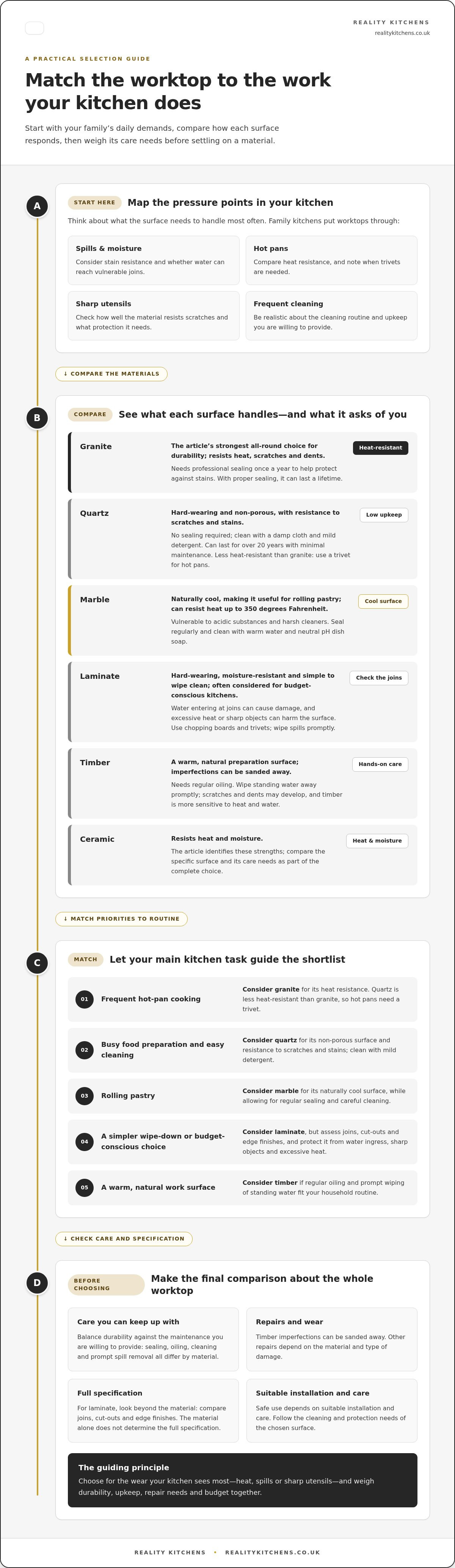
The toughest worktop isn’t automatically the easiest choice for a busy family. Granite is described as the most durable kitchen worktop, resisting heat, scratches and dents, but it needs occasional sealing. Quartz is also highly durable and resists scratches and stains, with no sealing required, though it’s less heat-resistant than granite. These are two strong options when comparing durable kitchen worktops for families.
Family life puts worktops through spills, hot pans, sharp utensils and frequent cleaning, so appearance is only part of the decision. To find a surface that suits your household, weigh its durability against the care it needs instead of choosing on looks alone.
This guide compares the qualities that matter most, including heat and moisture resistance, stain protection and upkeep. It also explains how laminate, timber, marble and ceramic differ, helping you focus on a worktop that suits your kitchen and the way your family uses it.
Key Takeaways
- Match the surface to your family’s routines, cleaning habits and budget, rather than choosing on appearance alone.
- Learn why laminate can be practical for everyday use, and where moisture at joins calls for extra care.
- Compare worktop materials for cooking and food preparation, including how their strengths affect daily use.
- Use a simple decision guide to weigh durability, maintenance and the demands of your kitchen before choosing.
What should you consider when choosing kitchen worktops?
Start with what your worktop needs to handle: family meals, hot pans, spills and everyday cleaning. Then compare each material’s upkeep and likely longevity, not just its appearance.
Wood worktops
Timber brings a warm, natural surface, but it needs regular oiling and standing water should be wiped away to help prevent damage. Proper maintenance can support its antibacterial benefits, while scratches and dents may develop through daily use. Unlike quartz, wood needs more hands-on care; imperfections can be sanded away, giving it a repair route that hard, non-porous surfaces don’t share.
Quartz worktops
Quartz combines natural crystals with resins and pigments to create a hard-wearing, non-porous surface. It resists scratching and staining, making it a practical choice for busy preparation areas. Clean it with a damp cloth and mild detergent; it doesn’t need sealing. Quartz can last for over 20 years with minimal maintenance, although it’s less heat-resistant than granite, so use a trivet for hot pans.
Practical worktop considerations
Marble’s natural coolness suits rolling pastry, and it can resist heat up to 350 degrees Fahrenheit. However, it’s vulnerable to acidic substances and harsh cleaners, so use warm water and neutral pH dish soap. Regular sealing helps prevent stains, and natural-stone suppliers should be certified by the Ethical Stone Register. Laminate is easy to maintain with a simple wipe-down, but protect it from sharp objects and excessive heat.
No single worktop material is required for every UK kitchen. Safe use depends on suitable installation and care. Clean each surface according to its needs: mild detergent suits quartz, while marble needs neutral pH soap. Timber needs oiling and prompt removal of standing water. Wood imperfections can be sanded away; other repairs depend on the material and type of damage.
| Material | Everyday use | Upkeep |
|---|---|---|
| Timber | Warm preparation surface | Regular oiling; wipe standing water |
| Quartz | Resistant to scratches and stains | Damp cloth and mild detergent |
| Marble | Cool surface for pastry | Seal regularly; avoid acidic cleaners |
| Laminate | Simple to wipe clean | Use boards and trivets for protection |
Balance your kitchen’s daily demands with the care you’re willing to provide and the surface’s repair needs. Then compare suitable options within your budget.
The Science of Choosing a Worktop – What Matters Most?
Compare how each surface handles everyday impacts, heat, moisture and cleaning. When budgeting, consider the complete specification, not just the material.
Laminate worktops
Laminate worktops offer a hard-wearing surface that resists moisture and is not easily scratched or cracked. They’re often considered for budget-conscious kitchens, but the material alone doesn’t determine the full specification. Compare details such as joins, cut-outs and edge finishes. Moisture can still cause damage if water enters at joints, and humidity can affect the worktop. Wipe spills promptly, and use chopping boards and trivets to protect the surface from sharp objects and excessive heat.
Quartz worktops
Quartz worktops combine natural quartz crystals with resins and pigments, forming a hard-wearing, non-porous surface. They resist scratches and stains, and can last for over 20 years with minimal maintenance. Clean quartz with a damp cloth and mild detergent; it doesn’t need sealing. Its key limitation is heat: quartz is less heat-resistant than granite, so place hot pans on a trivet instead of directly on the surface. That small habit helps protect its finish during everyday cooking.
Granite worktops
Granite can be a durable choice for kitchen worktops, though its suitability depends on how you use and maintain it. Its heat resistance suits busy cooking areas, but it still needs protection against stains. Have granite professionally sealed once a year, and promptly wipe wine or citric acids with a damp cloth and mild detergent. With proper sealing, granite can last a lifetime. It’s a compelling choice for longevity if you’re comfortable with periodic maintenance.
For a fair comparison, weigh laminate’s straightforward cleaning against its vulnerable joins, quartz’s stain resistance against its heat limit, and granite’s durability against annual sealing. Consider the wear your kitchen sees most, whether from hot pans, spills or sharp utensils. Then assess the material, finish and care requirements as one complete choice.
What Should You Look for in a Family Kitchen Worktop?
For family kitchens, choosing a worktop involves balancing durability, resistance to heat and scratches, and maintenance needs. Quartz also offers strong durability and stain resistance. The better fit depends on your cooking habits, preferred level of upkeep and budget.
Worktops for cooking and meal preparation
For pastry-making, marble’s naturally cool surface can be useful, but it needs regular sealing and careful cleaning. Ceramic resists heat and moisture, while quartz offers a non-porous preparation surface that resists scratches and stains. Granite handles heat well but needs periodic sealing. Match the worktop to your routine: frequent baking may favour a cool surface, while busy meal preparation calls for easy cleaning.
Durability by worktop material
Granite is the strongest all-round choice for durability among these materials, but annual professional sealing helps protect it against stains. Quartz resists scratches and staining with minimal maintenance, though it is less heat-resistant than granite. Laminate is hard-wearing and moisture-resistant, but water can enter at its joints. Timber can be sanded to address imperfections, but it is more sensitive to heat and water.
For a more sustainable choice, compare documented recycled content and material sourcing rather than relying on colour or appearance. Ask what the worktop contains and how it was produced: a “natural” or “solid surface” description alone doesn’t establish recycled content. Ethical sourcing matters particularly for natural stone, where the Ethical Stone Register provides a certification benchmark.
A worktop can help create a cohesive kitchen, but no material alone guarantees a higher home value. Consider how its colour, finish and condition work with the cabinets and room. For a useful budget comparison, include the material, fabrication, cut-outs, finish and ongoing care. This gives a clearer picture than comparing material categories alone, especially when sealed stone or regularly oiled timber needs continued upkeep.
Family worktop durability and selection criteria
Family durability depends on more than a scratch-resistant surface. Think through your household’s routine: frequent cooking, children’s spills, hot pans and the cleaning you’ll realistically keep up with. Quality worktops can last from 10 years to well over 30 years, depending on material and maintenance, so care requirements matter alongside initial appearance.
Use each material’s weak points to guide your choice. Compact laminate is more susceptible to heat damage and heavy impacts than quartz or granite. Laminate can be hard-wearing, but moisture entering at joins can damage it. Quartz resists stains and scratches, while granite combines strong heat resistance with the need for periodic sealing.
- For simpler upkeep: quartz needs no sealing, and ceramic worktops don’t need sealing either.
- For fewer moisture concerns: sintered stone is non-porous and requires no sealing.
- For a repairable natural material: timber imperfections can be sanded away, but the surface needs regular oiling.
- For heat and impact resistance: compare granite with quartz, remembering quartz is less heat-resistant.
Don’t choose by thickness alone. Most worktops are 20–40 mm thick, but thickness has little impact on durability, which is primarily determined by material. Instead, consider the joins and edges where spills may sit, and whether your normal cleaning routine suits the surface. A sealed stone worktop needs a different care commitment from a wipe-clean surface.
Rank your priorities: everyday impact resistance, stain protection, heat tolerance, cleaning effort and maintenance. Then rule out materials whose care demands don’t suit your household. If low upkeep matters most, compare non-porous options. If you prefer natural stone, include sealing in your long-term care plan. This makes the choice specific to your family’s needs, not just the look of the surface.
Ready to compare suitable kitchen worktop options for your home and daily routine?
Reality Kitchens: Bespoke Kitchen Design
Reality Kitchens can help turn your family’s priorities into a considered kitchen plan, matching worktop choices to cooking routines, cleaning habits and your preferred look. Its bespoke kitchen design brings those decisions together, with kitchen worktops and components completing the scheme.
Consider your options when weighing material trade-offs or planning a kitchen where worktops, components and appliances need to work together. Natural stone may suit one household, while a lower-maintenance surface may better fit another. The right choice depends on how your family uses the kitchen each day.
If you’re ready to plan a family kitchen around the way you live, contact Reality Kitchens.
Shape a Kitchen Around Family Life
Picture how your kitchen needs to work over time. Think beyond today’s meals: where will children prepare snacks, where will groceries be unpacked, and how will several people move through the room? These routines can help you set priorities before choosing a surface.
Choosing durable kitchen worktops for families is part of a wider design decision. Reality Kitchens can incorporate worktop choices into a bespoke kitchen plan, alongside components and appliances. In-home visits help shape the design around your space and household needs, rather than treating the worktop as a separate choice.
Start a conversation about the kitchen you want to create. Contact Reality Kitchens for advice, and take your next step towards a kitchen that feels considered, practical and personal.
Frequently Asked Questions
How much do quartz worktops cost?
Quartz worktop pricing is specific to each project, and the total is provided after a quote request. Costs depend on dimensions, specification, edge profile and fabrication details such as sink or hob cut-outs. These choices affect the material and workshop work required. For a useful comparison, assess complete worktop specifications rather than comparing material labels alone.
Which Worktop Requires the Least Maintenance?
Sintered stone is low-maintenance because it needs no sealing; quartz and ceramic also require no sealing. For a straightforward routine, wipe the surface with a damp cloth and a suitable everyday cleaner, then dry areas around taps. Avoid abrasive pads unless the material’s care guidance allows them. Low maintenance still involves regular cleaning, especially around food-preparation areas.
Is quartz better than granite?
Neither is universally better. Quartz suits households that prioritise consistent colour and straightforward upkeep, while granite appeals if you prefer the individual pattern of natural stone. Granite has stronger heat resistance; quartz resists stains and scratches but needs protection from hot pans. Compare both with your cooking habits and preference for a uniform engineered finish or natural variation.
What are the pros of granite worktops?
Granite offers strong heat resistance, resists scratches and dents, and has distinctive natural patterns. Each slab can have its own veining and colour variation, making the worktop a visual feature as well as a working surface. Compare the pattern and colour with your cabinet choices and kitchen lighting, since a small sample may not show the full variation.
What’s the most durable worktop?
Granite is described as the most durable overall because it resists heat, scratches and dents. Its long service life depends on proper care, including periodic sealing to limit staining. For durable kitchen worktops for families, choose granite if heavy daily use matters more to you than avoiding maintenance. It may be less suitable if you want a surface that needs no sealing.
What’s the most stain-resistant kitchen worktop?
Quartz is among the most stain-resistant choices because its non-porous surface limits absorption. That helps with common family spills such as juice or sauce, but it’s still sensible to wipe messes promptly. Use a damp cloth and mild detergent, and prepare coloured foods on a chopping board. This routine helps preserve the surface’s appearance without specialist stain treatments.


