

Could the very stone you've fallen in love with in a glossy showroom actually be the wrong choice for your specific Cheshire home? It's a common worry for homeowners who want the prestige of natural stone but fear the practical reality of red wine stains or hot pans. You've likely heard a dozen different opinions on heat resistance and durability, leaving you more confused than when you started. When deciding between quartz vs granite worktops Cheshire, the "right" answer isn't found in a brochure; it's found in your daily habits and your kitchen's unique layout.
We understand that a bespoke kitchen is a significant investment, and you deserve total transparency regarding costs and performance. This guide provides the definitive comparison you need to choose with confidence. We'll break down the technical differences between engineered quartz and natural granite, whilst addressing the hidden costs often found in traditional showroom pricing. By the end, you'll know exactly which surface offers the best value and longevity for your home, ensuring your kitchen remains a beautiful, stress-free space for years to come.
Key Takeaways
- Learn why quartz offers superior stain resistance for busy households whilst granite provides unmatched heat resistance for serious home cooks.
- Understand how to match your surface choice to your family's lifestyle, ensuring your bespoke kitchen remains durable against daily wear and tear.
- Discover the definitive differences between quartz vs granite worktops Cheshire to avoid the common pitfalls of choosing materials under artificial showroom lighting.
- Identify the specific factors that influence your final quote, from edge profiles to slab sizes, allowing you to maximise your budget for premium materials.
- See how a professional home visit and a ten-year guarantee on components provide the peace of mind needed for a high-end kitchen transformation.
The Great Debate: Quartz vs Granite Worktops in Cheshire Homes
Choosing your worktop is arguably the most pivotal decision in any bespoke kitchen renovation. It’s the surface that anchors your design, defines your colour palette, and endures the heaviest daily use. Across Cheshire, from the historic streets of Knutsford to the modern developments in Northwich, the choice between quartz vs granite worktops Cheshire often defines the entire character of the home. Whilst glossy brochures might showcase beautiful finishes, seeing these materials in the unique light of your own kitchen is the only way to truly understand their impact.
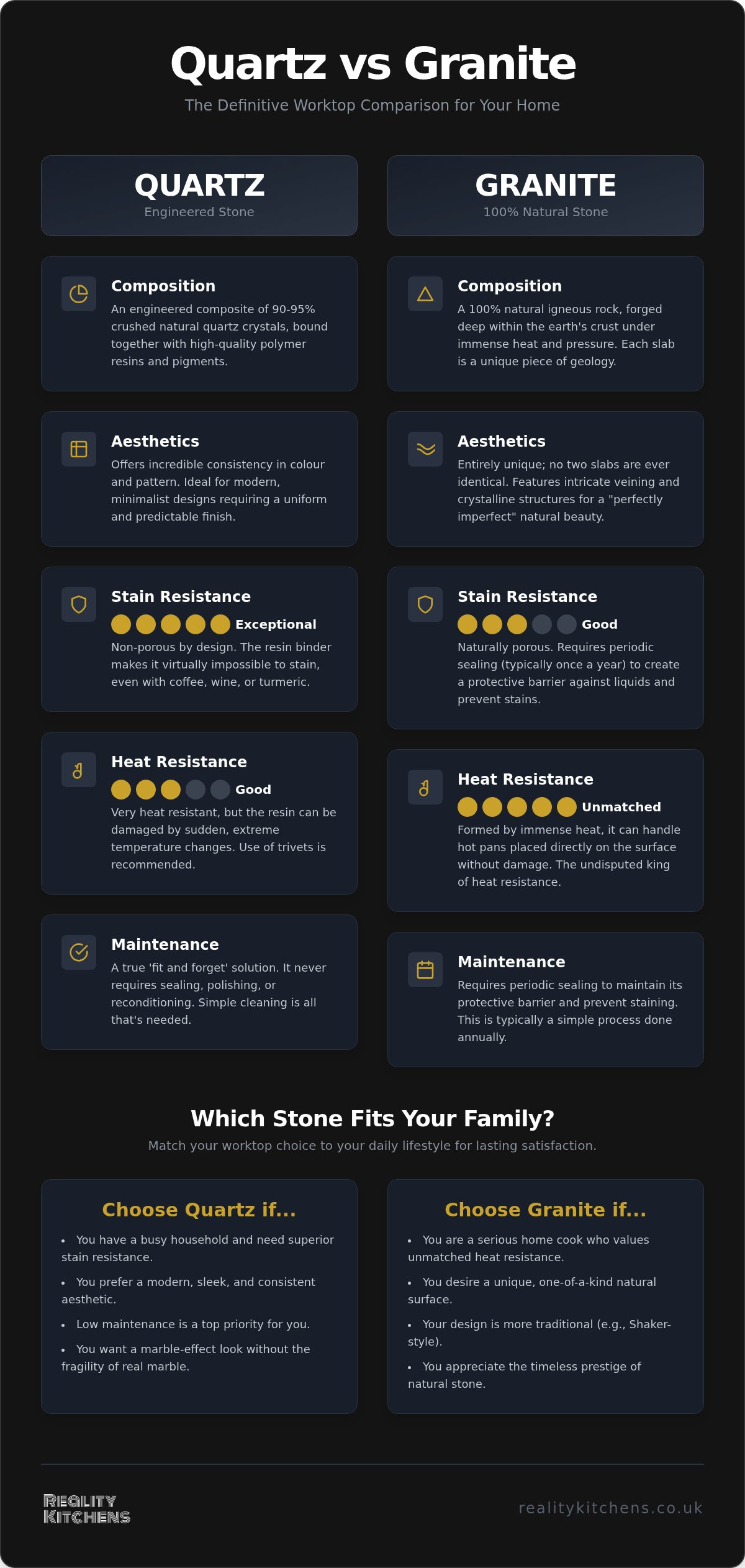
Granite is a 100% natural igneous rock, forged deep within the earth’s crust under immense heat and pressure. It’s a raw piece of geological history brought directly into your home. In contrast, quartz is an engineered stone. It typically consists of 90-95% crushed natural quartz crystals mixed with high-quality resins and pigments. This human-led innovation allows for a level of control over aesthetics and performance that nature can't always provide. Both materials are premium choices, yet they appeal to very different sensibilities.
The Aesthetic Appeal of Natural Granite
There is a certain prestige in knowing your kitchen surface is entirely unique. Because granite is a product of nature, no two slabs are ever identical. You’ll find intricate veining, deep crystalline structures, and unpredictable patterns that an engineered stone simply cannot replicate. It’s a favourite amongst homeowners in more traditional Cheshire properties, particularly those installing Shaker-style cabinetry or Georgian-inspired designs. Owning a granite worktop is about embracing the "perfectly imperfect" beauty of the natural world and the longevity of a material that has already stood the test of time for millennia.
The Modern Versatility of Quartz
If your vision for a new kitchen involves clean lines and a sleek, contemporary finish, quartz is likely your best ally. Because it's manufactured, quartz offers incredible consistency in both colour and pattern. This makes it the preferred choice for minimalist renovations in areas like Altrincham and Hale, where a uniform aesthetic is often desired. You can achieve stunning marble-effect finishes without the porous fragility of real marble, giving you a high-end look that stands up to modern life. For many homeowners considering quartz vs granite worktops Cheshire, the ability to predict exactly how the finished surface will look alongside their chosen cabinetry is a major selling point.
Technical Breakdown: Durability, Maintenance, and Performance
Understanding the technical specifications of quartz vs granite worktops Cheshire is about more than just comparing numbers on a hardness scale. It's about how the surface behaves when life happens in your kitchen. Both materials sit high on the Mohs scale of mineral hardness, meaning they'll easily withstand the friction of daily food preparation. However, they possess distinct physical personalities. Granite is a monolithic natural slab, whilst quartz is a dense composite. This difference in structure dictates how they respond to spills, heat, and heavy impacts.
Dropping a heavy cast-iron skillet is the ultimate test of impact resistance. Whilst both materials are incredibly dense, they aren't invincible. A sharp blow to a finished edge can cause chipping in either stone. Because granite is a natural formation with internal fissures, a chip can sometimes be more difficult to repair invisibly compared to the uniform structure of quartz. If you're looking for a surface that's easier to maintain over the long term, seeing bespoke kitchen worktop samples in your own home can help clarify which material feels most robust to you.
The Maintenance Reality: Sealing vs Scouring
Granite's natural origin means it possesses a degree of porosity. Porosity refers to the microscopic voids within a material that allow liquids and bacteria to penetrate the surface, potentially leading to deep-seated stains and hygiene issues. To combat this, granite requires periodic sealing, typically once a year, to maintain a protective barrier. Quartz is non-porous by design; the resin binder fills every microscopic gap during manufacturing. This makes quartz naturally hygienic and virtually impossible to stain with common kitchen culprits like beetroot or turmeric. You'll never need to seal quartz, making it a "fit and forget" solution for busy households.
Heat and Scratch Resistance Comparison
Granite is the undisputed king of the "hot pan" test. Having been forged in volcanic heat, a granite slab can comfortably withstand temperatures up to 250°C. You can move a roasting tin directly from the oven to the worktop without fear of damage. Quartz is different. The resins used to bind the crystals can scorch, discolour, or even crack if exposed to extreme heat. We always recommend using a trivet with quartz to ensure its longevity. Regarding scratches, both materials are exceptionally resilient. You'll struggle to scratch either with a standard kitchen knife, though we'd still suggest using a chopping board to protect your blade's edge rather than the stone itself.
The Cheshire Lifestyle Check: Which Stone Fits Your Family?
Choosing between quartz vs granite worktops Cheshire isn't just a technical decision; it's a lifestyle one. Your kitchen is the engine room of your home, and the right surface should support your daily habits rather than add to your chores. Whether you’re managing a chaotic morning school run in Hartford or hosting an elaborate dinner party in Knutsford, your stone needs to perform under pressure. Understanding how these materials interact with your specific environment is the key to long-term satisfaction.
For the "Social Host" with a large, open-plan kitchen, lighting plays a massive role. Large Cheshire kitchens often feature expansive windows or bi-fold doors that flood the room with natural light. Quartz, with its consistent pigment, reflects light evenly. This makes it much easier to plan massive kitchen islands where multiple slabs must meet seamlessly. On the other hand, the "Serious Chef" who spends hours at the range might prioritise granite's volcanic resilience. If you're frequently moving heavy, scorching pans from the hob to the side, granite’s heat tolerance is a genuine game-changer that removes the need for constant trivet-hunting.
Quartz: The Practical Luxury Choice
If you have young children, you've likely seen the damage a spilled glass of blackcurrant squash or a forgotten lemon slice can do. Quartz is the "fit and forget" champion for busy families. Because it's engineered to be non-porous, it passes the red wine and lemon juice test with ease. It's particularly popular for bright, airy renovations in Northwich and Hartford, where homeowners want a sleek, modern look that doesn't require an annual maintenance schedule. Its predictable pattern also means you can choose your exact finish during a home visit, knowing it'll look identical once installed.
Granite: The Character and Prestige Choice
There's a specific tactile pleasure in natural stone that engineered materials can't quite replicate. Granite feels solid, cold to the touch, and carries a visible depth that adds immediate warmth to rural Cheshire barn conversions or period properties. It’s for the homeowner who views their kitchen as a piece of art. When weighing up quartz vs granite worktops Cheshire, many choose granite for its one-of-a-kind status. Whilst it requires a quick annual seal to guard against those red wine spills, many find this a small price to pay for a statement piece. In the unique light of a Cheshire afternoon, the crystalline structures in a granite slab provide a visual richness that ensures your kitchen is unlike any other in the county.
Cost Analysis: Realistic Prices for Premium Worktops
Budget is usually the final deciding factor when comparing quartz vs granite worktops Cheshire. Many homeowners get caught out by simple "price per square metre" estimates they find online or in brochures. These figures are often misleading because they ignore the complexity of bespoke fabrication. A quote for a standard rectangular run is very different from one involving undermount sink cut-outs, recessed drainers, or intricate edge profiles. The true cost is found in the details of the installation and the specific yield of the slabs chosen for your layout.
Generally, entry-level granites can be more affordable than premium, high-veined quartz options. However, rare "exotic" granites quickly surpass the cost of even the most luxurious engineered stones. It isn't just about the material; it's about the yield. If your kitchen island requires 3.2 metres of stone and the slab is only 3 metres, you're paying for a whole second slab. This is where professional, bespoke planning becomes essential to protect your investment and avoid unnecessary waste. Every cut-out and polished edge adds to the labour, so understanding these variables early ensures there are no hidden surprises in your final quote.
Why Showroom Overhead Affects Your Worktop Quote
Maintaining a high-end physical shopfront in premium Cheshire locations like Altrincham or Wilmslow is an expensive endeavour. These significant business costs are inevitably passed on to the customer through higher margins on materials. We've chosen a different path. By operating without a traditional showroom, Reality Kitchens sources the same premium stone from the same leading suppliers but at more realistic prices. Seeing samples during a home visit is actually more beneficial; it allows you to see how the stone looks under your own kitchen's lighting rather than harsh, artificial showroom bulbs.
Maximising Your Budget with Bespoke Design
A clever designer doesn't just make a kitchen look good; they make it cost-effective. Bespoke planning reduces total project cost by minimising wastage and ensuring every centimetre of your slab is utilised effectively. For instance, we often suggest using slab offcuts to create matching windowsills or surfaces for a utility room. This adds a sense of luxury to secondary spaces without the cost of ordering an additional slab. To see how we can stretch your budget further, book a bespoke kitchen design consultation today.
Longevity is the final piece of the value puzzle. Whilst some suppliers offer vague promises, we provide a ten-year guarantee on our kitchen components. This gives you total peace of mind that your choice of quartz vs granite worktops Cheshire is a sound financial decision. You aren't just buying a surface; you're investing in a durable, high-performance workspace that will serve your family for a decade or more.
The Design-First Approach: Selecting Your Stone with Reality Kitchens
Choosing a worktop in a showroom is one of the most common mistakes Cheshire homeowners make. Under the harsh, artificial glare of retail spotlights, a stone might look perfect, but once it's installed in your home, the reality can be quite different. A slab that looked warm and inviting in a shop can appear cold or mismatched when placed alongside your actual cabinetry and under your specific kitchen lighting. At Reality Kitchens, we believe the worktop shouldn't be an afterthought or a separate purchase; it must be the foundation of your entire design journey.
When weighing up quartz vs granite worktops Cheshire, we look at the bigger picture. We consider how the intricate veining of a natural granite slab will interact with the grain of your bespoke cabinets, or how a sleek quartz surface will reflect your planned pendant lighting. Our process ensures that your choice of stone works in harmony with your integrated appliances and plumbing requirements from day one. By integrating material selection into the total design phase, we eliminate the risk of aesthetic clashes or technical installation issues later in the project.
The Benefit of the Home Visit Design Service
There is no substitute for seeing a sample in its future environment. Our home visit service allows you to see how a "Calacatta-effect" quartz or a deep-toned granite looks under your own LED task lighting and the natural light from your windows. This is the only way to ensure the colour and texture truly complement your home. During these visits, we also discuss the practicalities on-site, such as plumbing for undermount sinks or the specific requirements for high-end integrated appliances. This level of detail is what defines our bespoke kitchen design Northwich service, providing luxury results without the unnecessary showroom premium.
A Ten-Year Guarantee for Peace of Mind
We don't just care about how your kitchen looks on the day of installation; we care about how it performs for years to come. Whether you decide on quartz vs granite worktops Cheshire, you need to know that your investment is protected. We provide a ten-year guarantee on our kitchen components, reflecting our total confidence in the materials we source and the skill of our partners. Our commitment to using trusted local installers ensures a perfect finish every time, from the precision of the mitred joints to the final polish of the stone. This comprehensive approach to kitchen design and installation Northwich ensures that your new kitchen remains a source of pride and functionality for at least a decade.
Transform Your Cheshire Kitchen with Confidence
Choosing between quartz vs granite worktops Cheshire shouldn't be a source of stress; it's the final flourish that brings your bespoke design to life. Whether you prioritise the volcanic heat resistance of natural granite or the effortless, non-porous resilience of engineered quartz, your choice should reflect how you actually live. By moving away from artificial showroom lighting and focusing on how materials behave in your own home, you ensure a result that's both beautiful and functional.
We're here to guide you through every cut-out and edge profile, providing premium materials at realistic prices by cutting out the overhead of a physical shopfront. With our ten-year guarantee on components and expert local installation, you can focus on the joy of your new space rather than the logistics of the build. It's time to bridge the gap between your vision and your reality with a surface that stands the test of time.
Book your free Cheshire home design visit today and let's start planning a kitchen that truly works for your family.
Frequently Asked Questions
Is quartz or granite more expensive in Cheshire?
The cost comparison for quartz vs granite worktops Cheshire depends entirely on the rarity of the stone and the complexity of your kitchen layout. Whilst entry-level granite is frequently more budget-friendly than high-end engineered quartz, rare natural slabs can be significantly more expensive. Our "no showroom" model ensures you receive realistic pricing on both materials, allowing your budget to go further on premium finishes without the inflated margins of high-street firms.
Can I put hot pans directly onto a quartz worktop?
You should avoid placing hot pans directly onto a quartz surface. The resins used to bind the quartz crystals can discolour or even crack when exposed to extreme heat. It's always best to use a trivet or heat protector to maintain the integrity of the stone. In contrast, granite can withstand much higher temperatures; however, we recommend caution with both materials to ensure the long-term beauty of your bespoke kitchen investment.
How often do I need to seal a granite worktop?
Most granite worktops require sealing approximately once every twelve months. Because granite is a natural, porous stone, it has microscopic voids that can absorb liquids if left unprotected. A simple annual treatment creates a barrier against stains and bacteria, keeping the surface hygienic and beautiful. If you prefer a completely maintenance-free option, quartz is non-porous by design and never requires sealing or special treatments throughout its entire lifespan.
Which is better for a kitchen island: quartz or granite?
Quartz is often the superior choice for large kitchen islands because its manufactured consistency makes seams and joins almost invisible. If your island requires multiple slabs, quartz ensures the pattern flows perfectly across the entire surface. However, if you want a unique, one-of-a-kind statement piece that acts as a natural work of art, a single large slab of granite provides a depth and character that engineered stone cannot replicate.
Does quartz look like real marble?
Modern quartz can replicate the look of real marble with incredible accuracy, particularly popular styles like Calacatta or Carrara. These engineered slabs offer the iconic grey veining and bright white backgrounds homeowners love, but without the high porosity and soft nature of genuine marble. Choosing a marble-effect quartz gives you the prestige of the look whilst providing a durable, stain-resistant surface that stands up to the demands of a busy household.
Can I see worktop samples in my own home before buying?
Yes, we believe seeing samples in your own home is the only way to make an informed decision. Showroom lighting is often deceptive; it doesn't reflect how a stone will look under your specific kitchen's LED task lights or natural sunlight. During our home design visits, we bring a range of samples so you can compare textures and colours directly against your cabinetry and flooring in their true environment.
Are quartz worktops more hygienic than granite?
Quartz is naturally more hygienic than granite because it is entirely non-porous. Its dense structure prevents liquids, oils, and bacteria from penetrating the surface, making it exceptionally easy to sanitise with just soap and water. Whilst granite is perfectly safe for food preparation, it relies on an intact seal to prevent bacteria from settling in its natural pores. For families prioritising a "fit and forget" hygienic surface, quartz is the winner.
What happens if my quartz or granite worktop gets chipped?
If your worktop gets chipped, it can usually be repaired invisibly by a specialist using colour-matched acrylic resins. Whilst both quartz vs granite worktops Cheshire are incredibly tough, they can chip if struck by a heavy object on a finished edge. These repairs are durable and restore the surface's smooth finish. Our ten-year guarantee on kitchen components also provides additional peace of mind regarding the long-term reliability of your chosen materials.


