

The most sophisticated corner mechanism isn’t always the most useful one. For maximising kitchen corner storage, what matters is whether you can reach the items you actually keep there without disrupting the way you move around the kitchen.
If pans, appliances or pantry staples have vanished into a blind corner, you’re not alone. Rotating shelves, pull-out systems, corner drawers and simple fixed shelving all approach the problem differently. The right choice depends on your cupboard layout, the items you store and your daily routine.
This guide compares practical options and explains what each can make easier to store and reach. You’ll also find what to measure, from the cupboard’s shape and opening to nearby door and drawer clearances. With those details in hand, it’s easier to plan a corner that works with the surrounding cabinetry and keeps your kitchen straightforward to use.
Key Takeaways
- Identify whether your cupboard is a blind corner or has a direct or angled opening, as its shape affects which storage approaches may suit it.
- Compare fixed shelves, rotating carousels and pull-out systems by how they bring contents within reach, rather than assuming one option works best for every kitchen.
- When maximising kitchen corner storage, match the mechanism to the items you keep there and how often you need to access them.
- Measure the opening width, internal depth and nearby door or drawer clearances before planning a new storage arrangement.
- Consider the corner alongside the rest of the kitchen layout, so storage supports your routines and works with surrounding cabinetry.
Why kitchen corners become wasted space, and what to assess first
A corner can look generous from above but be awkward to use from the front. The problem is often not a lack of cupboard volume, but the gap between the space available and the space you can comfortably reach. Before choosing a storage mechanism, identify the cupboard shape and the specific frustration you want to solve.
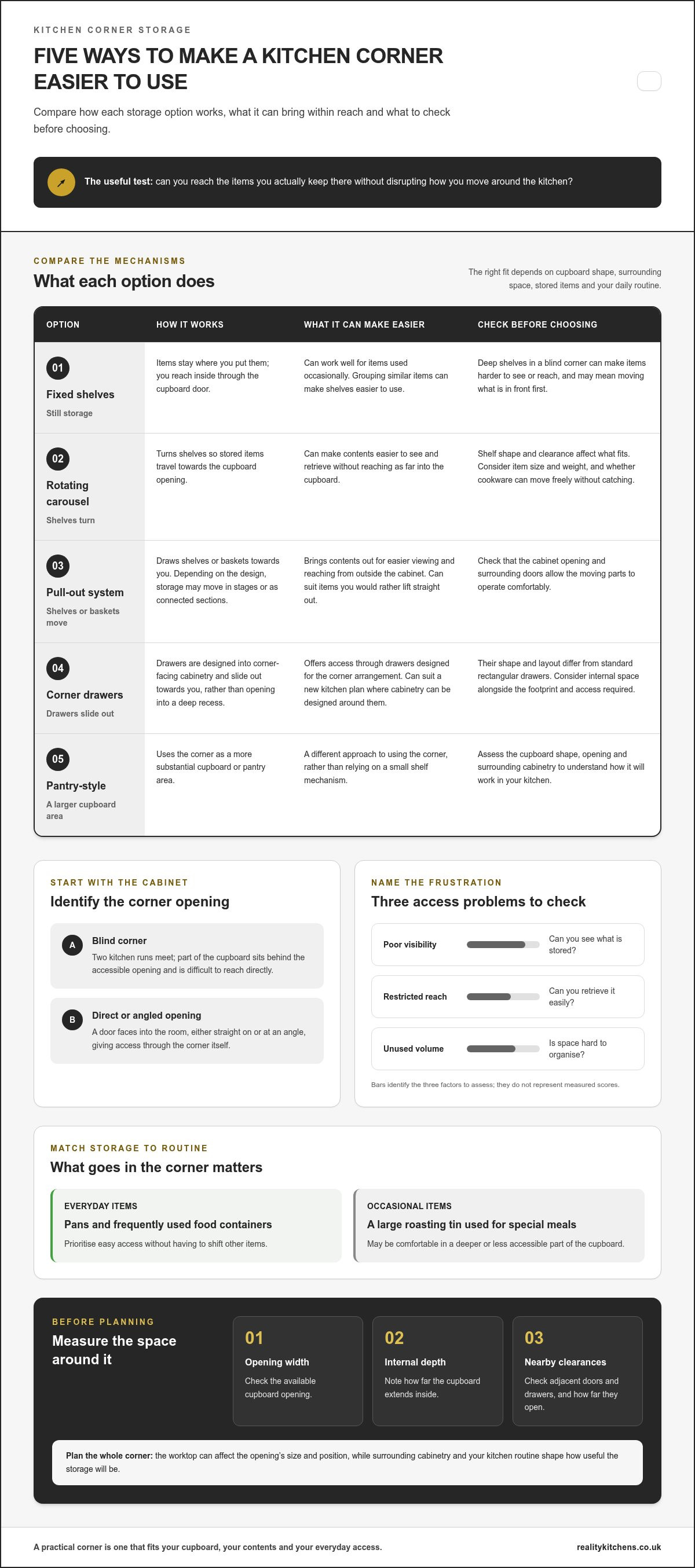
A blind corner cupboard is positioned where two kitchen runs meet, with part of the space sitting behind the accessible opening and difficult to reach directly. Its depth can hide items from view and mean moving or removing other things to get to them. By contrast, a corner unit with a direct opening, or an angled front facing into the room, gives access through a door positioned at the corner itself.
Kitchen cabinets have long been designed to balance storage and practical use; The history and evolution of kitchen cabinets offers useful context for how their role has developed. In a modern layout, even a well-sized cupboard can feel inefficient if its opening, neighbouring units or contents make everyday access awkward.
How to identify the type of kitchen corner you have
Stand in front of the corner and trace how the two cabinet runs meet. Does one run continue past the corner, leaving a narrower door on the other side? That often indicates a blind corner. Or does a door face you directly, either straight on or at an angle? That suggests a corner unit with a more direct opening.
Look beyond the cupboard itself. Adjacent doors and drawers may limit how far its door opens, while the worktop above can affect the size and position of the opening. Note whether the corner is already fitted or still part of a new kitchen plan. An existing cabinet has fixed boundaries; a new layout gives more scope to plan the corner alongside surrounding cabinetry.
Which corner-storage problem are you trying to solve?
Separate the frustration into three parts. Poor visibility means you can’t easily see what’s stored at the back. Restricted reach means you know an item is there but struggle to retrieve it. Inefficient use of cupboard volume means space remains empty or is filled with items that are difficult to organise. More than one issue may apply, but identifying the main one helps you compare solutions.
Next, consider what you store and how often you use it. Everyday pans or frequently used food containers need to be easy to reach without shifting other items. Occasional-use cookware, such as a large roasting tin brought out for special meals, may be comfortable in a deeper or less accessible part of the cupboard.
- Check access: can you reach the back without kneeling, stretching or unloading the front?
- Check visibility: can you see what is there before moving anything?
- Check your routine: does the cupboard suit the items you reach for most often?
These observations give you a practical starting point for maximising kitchen corner storage: match the arrangement to the cupboard’s shape and the way you use its contents.
Kitchen corner storage solutions: how each mechanism works
Corner-storage mechanisms differ in what they move and how far they bring your belongings towards the cupboard opening. Some keep shelves still, some rotate their contents, and others draw shelves out towards you. The best fit depends on the cabinet’s shape, the space around it and what you want to store, not simply on which mechanism sounds most advanced.
The main corner-storage types are fixed shelves, rotating carousels, pull-out systems, corner drawers and pantry-style storage. Each offers a different balance of access, visibility and usable space. Consider how it works and whether it addresses the particular problem you identified.
Rotating shelves, carousels and fixed corner shelves
Fixed shelves are the simplest arrangement: items stay where you put them, and you reach inside through the cupboard door. They can work well for things used occasionally, but shelves set deep in a blind corner may leave you feeling around for items or moving what’s in front first. Grouping similar items together can make fixed shelves easier to use.
A carousel turns its shelves so stored items travel towards the opening. This can make contents easier to see and retrieve without reaching as far into the cupboard. It doesn’t make every item equally accessible, though. Shelf shape and clearance affect what fits, and large or unusually shaped cookware may not sit neatly on a rotating shelf. Consider the size and weight of the items you plan to store, and whether they can move freely without catching on the cabinet or other contents.
Pull-out systems, corner drawers and pantry-style storage
Pull-out corner systems bring shelves or baskets towards you, making contents easier to see and reach from outside the cabinet. Depending on the design, storage may move in stages or as connected sections. This approach can suit items you’d rather lift straight out than retrieve from a deep shelf, but the cabinet opening and surrounding doors need to allow the moving parts to operate comfortably.
Corner drawers use a different cabinet arrangement from a typical blind-corner cupboard. Instead of opening into a deep recess, the drawers are designed into the corner-facing cabinetry and slide out towards you. Their shape and layout differ from standard rectangular drawers, so consider their internal space alongside the footprint and access required. They can suit a new kitchen plan particularly well, where the cabinet layout can be designed around them.
Pantry-style corner storage uses the corner as a more substantial cupboard or pantry area, rather than relying on a small rotating shelf or drawer arrangement. This can provide room to organise a broader range of provisions, but needs careful planning: available floor area, door position and nearby work zones all influence whether it will suit the way you use the kitchen.
For maximising kitchen corner storage, compare how each option moves contents, not just how much shelf space it appears to provide. If you’re planning a new layout, a bespoke kitchen design can bring the corner, surrounding cabinets and everyday routine into the same conversation.
How to compare corner units for access, capacity and everyday use
A useful comparison looks beyond how much space a corner unit appears to offer. Ask how much of that space you can see and reach when the cupboard is open, whether the mechanism suits your contents and whether it fits the cabinet and surrounding units. A system that moves smoothly in one layout may not work in another if doors, drawers or the available opening get in its way.
| Storage type | Access | Usable capacity | Cupboard shape | Contents to consider |
|---|---|---|---|---|
| Fixed shelves | Direct reach through the opening; deeper areas can be harder to see or retrieve from. | Uses the available shelf area, though some space may be inconvenient to reach. | Can suit straightforward cupboards with a suitable opening. | Items used occasionally or stored in organised groups. |
| Rotating carousel | Turning shelves bring different contents towards the opening. | Useful shelf area depends on shelf shape, clearance and item size. | Needs a cabinet arrangement that allows the shelves to rotate freely. | Items that fit comfortably on the turning shelves. |
| Pull-out system | Sliding shelves or baskets move stored items towards you. | Accessible area depends on the system and space taken up by its moving parts. | Requires a compatible opening and clear movement around adjacent units. | Contents that benefit from being brought forward for lifting or sorting. |
| Corner drawers or pantry-style storage | Drawers slide out; pantry-style units provide a larger cupboard area. | Varies with the cabinet design and internal layout. | Often needs to be considered as part of the overall cabinet plan. | Grouped cookware, provisions or other contents suited to the design. |
Match the storage mechanism to what you keep there
Think about lifting as well as storing. If you keep heavier cookware in the corner, prioritise an arrangement that brings it within comfortable reach and lets you lift it without leaning deep into the cupboard. Small packets or loose accessories may be easier to manage in contained baskets, while larger dishes can benefit from open shelf space. How often you use an item matters too: daily essentials deserve easier access than things brought out only occasionally.
For example, you might want frying pans close at hand for everyday cooking, but be content to store a large serving dish used for family occasions further into the cupboard. The same corner can serve both purposes if its layout puts frequently used items in the easiest position to reach.
Compare access, capacity and maintenance needs
Moving shelves can improve visibility, but they need room to travel and their surfaces or runners may need routine cleaning. Fixed shelves have fewer moving parts, yet can leave contents at the back less accessible. Consider whether a mechanism takes up space that could otherwise hold items, and balance that against the convenience of bringing stored contents towards you.
Cabinet dimensions set practical limits. Opening width, internal depth and clearance around nearby doors and drawers can all affect what fits and moves freely. So, maximising kitchen corner storage means comparing options against your actual cupboard and routine, not choosing by capacity alone.
How to plan and organise kitchen corner storage step by step
A quick cupboard audit can prevent a promising storage idea from becoming an awkward fit. Work through the space in order: clear it, measure it, decide what belongs there, then plan access and storage zones. This gives you useful information before choosing a mechanism, as moving parts need enough room to operate alongside the cabinet and nearby fittings.
- Empty the cupboard. Take everything out so you can see the full interior, including its shape and any obstructions.
- Measure the space. Record the opening width and internal depth, and note the cabinet’s shape. Don’t assume it follows standard dimensions.
- Sort the contents. Group items by type and how often you use them. Set aside anything that belongs elsewhere or is no longer useful.
- Assess access. Think about what’s difficult to see, reach or lift, and whether nearby doors, drawers or handles get in the way.
- Plan storage zones. Decide which items need the easiest access and which can be stored further back before selecting an arrangement.
Measure the cupboard and map the surrounding layout
Measure the clear opening, internal depth and usable width inside the cupboard. Note its shape too, as a blind corner and a direct-opening unit offer different space to work with. Then check clearances: open nearby cabinet doors and drawers, and consider handles, appliances and the route through the kitchen. A mechanism needs room to move without clashing with these features.
Before planning, record the opening width, internal depth, cupboard shape and clearances around nearby doors and drawers. For a new kitchen, consider the corner as part of the full cabinet and worktop run, so its opening and access work with the overall layout rather than in isolation.
Organise the corner around a realistic kitchen routine
With the cupboard empty, group contents into categories such as pans, serving dishes or food containers. Within each group, separate everyday items from those used occasionally. This reveals what needs the clearest access and helps you choose zones that support your routine, rather than simply filling every shelf.
Return frequently used items to the easiest-to-reach area and reserve deeper or less accessible spaces for occasional-use pieces. Leave enough room for shelves or baskets to move freely. Oversized cookware can block access or prevent moving storage from operating as intended, so avoid forcing items into a space that doesn’t accommodate them comfortably.
If the corner forms part of a wider redesign, a home visit can help connect your measurements and storage habits with the surrounding cabinetry. Plan your bespoke kitchen design around the space and the way you use it.
Bring corner storage into a bespoke kitchen design
A corner unit affects more than what fits inside it. Its position can shape how you move between the sink, hob and preparation space, how neighbouring doors open, and how you use the worktop. That’s why corner storage is most useful when planned as part of the whole kitchen, rather than added as an isolated fix after the cabinets have been arranged.
For maximising kitchen corner storage, start with the priorities you’ve already identified: what you want to store, what needs to be easiest to reach and how the corner connects with the rest of the room. These details help make the design practical as well as considered. The bespoke kitchen design guide explores how a tailored plan can bring individual requirements and the wider layout together.
What a home-based kitchen design discussion can cover
Reality Kitchens visits customers at home to understand the space and the way they want their kitchen to work. Seeing the existing layout in person puts cupboard access into context: the corner can be considered alongside adjacent cabinet runs, worktops and the everyday routes through the room.
You can discuss what your household wants to store, which items you use most often and where current access feels awkward. These requirements inform the bespoke design, so the corner is considered in relation to your home rather than treated as a standard space with a one-size-fits-all answer.
Turn storage ideas into a considered kitchen plan
Clear priorities make design decisions easier. If easy access to everyday cookware matters most, that can guide how the corner relates to nearby preparation and cooking areas. If you need to store larger or less frequently used items, the wider cabinet plan can take those needs into account too. Reality Kitchens supplies kitchen components and worktops for bespoke projects, bringing the selected elements into a plan shaped around your requirements.
It also helps to think about the kitchen as a whole: the corner, neighbouring cupboards, worktop space and movement between key areas all influence how comfortably the room functions. For broader project planning, the dream kitchen design guide can help you develop your ideas into a clearer brief.
Bring your measurements, storage priorities and ideas together, then explore bespoke kitchen design with Reality Kitchens. A home-based discussion can help shape a kitchen around your space and the way you want to use it.
Make your next kitchen plan work harder
A corner that’s awkward today can become part of a kitchen that feels easier to use. Keep your measurements and storage priorities to hand as you consider your next step. They’ll help turn maximising kitchen corner storage from a general aim into a practical part of a layout designed around your home and routines.
Reality Kitchens works alongside trusted builders and installers, and supplied kitchen products are backed by a ten-year guarantee. With a considered plan, your corner can support the way you cook and move through the room, rather than becoming an afterthought.
Ready to shape a kitchen around the space you have and the way you live? Explore bespoke kitchen design with Reality Kitchens and take the first step towards a more personal, practical kitchen.
Frequently Asked Questions
What is the best way to use a blind corner kitchen cupboard?
Choose storage around what you need to reach, rather than trying to fill every recess. Keep frequently used items easiest to retrieve and reserve deeper areas for occasional-use pieces. For example, if you cook with a stockpot every week, it may deserve a more accessible position than a serving platter used only for special occasions. The right arrangement makes the cupboard useful in your routine, not just full.
Are pull-out corner units better than carousel shelves?
Neither is automatically better; each suits different cupboards and habits. A pull-out brings shelves or baskets towards you, which can help if you want to lift items out from the front. A carousel rotates stored contents into view, which may suit items that fit its shelf shape. Consider what you store, how you prefer to reach it and whether the cabinet has enough clearance for the mechanism to move.
Can you add pull-out storage to an existing kitchen corner cupboard?
Suitability depends on the cupboard’s internal shape, opening and available clearance. Compare its measurements with the fitting requirements before choosing a system, as an existing cabinet may need changes and some layouts won’t accommodate pull-outs. Reality Kitchens’ home visits help inform bespoke plans for homeowners in Northwich, Hartford, Weaverham, Winnington, Davenham, Knutsford, Cranage, Goostrey, Holmes Chapel, Tarporley, Helsby, Frodsham, Sandiway, Cuddington, Comerbach, Altrincham, Hale, Bowdon and Ashley.
How do you measure a kitchen corner cupboard for storage?
Measure the clear opening, interior depth and usable width inside the cabinet, then note its shape and any obstructions. Check the opening with the door in its normal open position, and account for hinges or internal supports that reduce usable space. If the cupboard isn’t square, take measurements at more than one point. Record everything together so you can compare the actual space with a system’s fitting requirements.
What should you store in a corner kitchen cabinet?
Store items that suit the cupboard’s shape and are comfortable to retrieve. Mixing bowls, serving dishes or cookware can work well if they fit without blocking other contents. For a deep corner that’s harder to reach, consider items you use less often, such as seasonal baking equipment. Avoid placing small loose objects behind larger pieces, where they can become difficult to spot or retrieve.
Are corner drawers a good use of kitchen space?
Corner drawers can make sense when the cabinet layout is designed to accommodate their shape and opening movement. They let you organise contents into separate compartments, which can be useful for keeping cooking tools or cloths together rather than stacked in a deep cupboard. Their angled or shaped fronts may affect how much fits, though, so compare the drawer dimensions with the size of the items you want to store.
How can I make a small kitchen corner easier to access?
Start by keeping the corner for items that genuinely belong there, and avoid stacking them so high that you can’t see what’s behind. Put the most frequently used pieces where you can retrieve them without moving several others first. Check that the cupboard door doesn’t clash with nearby handles or obstruct a walkway when open. A clear, practical arrangement can make a modest corner more useful without adding clutter.


