

When choosing soft close kitchen hinges, it helps to know whether a door that slams or catches needs a new hinge at all. The closing mechanism may still work properly while the door is out of alignment. But with several screws on a hinge, knowing which one to turn can feel like guesswork, and it’s natural to worry about making the problem worse.
Start with a careful diagnosis. This guide explains what hinge adjustments can change, how to make small, controlled tweaks and how to test the door’s position and closing action as you go. You’ll also learn to look for loose screws, dirt or visible damage, and recognise when adjustment alone is unlikely to restore a smooth close. Start gently and check the result after each change to work towards a door that sits evenly and closes quietly.
Key Takeaways
- Slamming, rubbing or uneven gaps can point to different causes, so note what the door is doing before adjusting anything.
- Hinge screws may affect side-to-side position, depth or height. Identify your hinge model before turning one.
- When choosing soft close kitchen hinges, don’t assume poor closing means replacement is needed. First consider whether the door is misaligned or the mechanism may be worn.
- Make small adjustments with the door supported where needed, then test its alignment and closing action before making another change.
- If careful adjustments don’t resolve the problem, record the hinge details and symptoms to guide your next step.
Why are your soft-close kitchen hinges not closing smoothly?
A door that slams, has uneven gaps, rubs against the cabinet or stops short of closing is giving you useful clues. These symptoms can have different causes, so don’t assume the hinge needs replacing straight away. The door may be out of alignment, something may be blocking its path, fixings may have loosened, or the soft-close mechanism may not be working as it should.
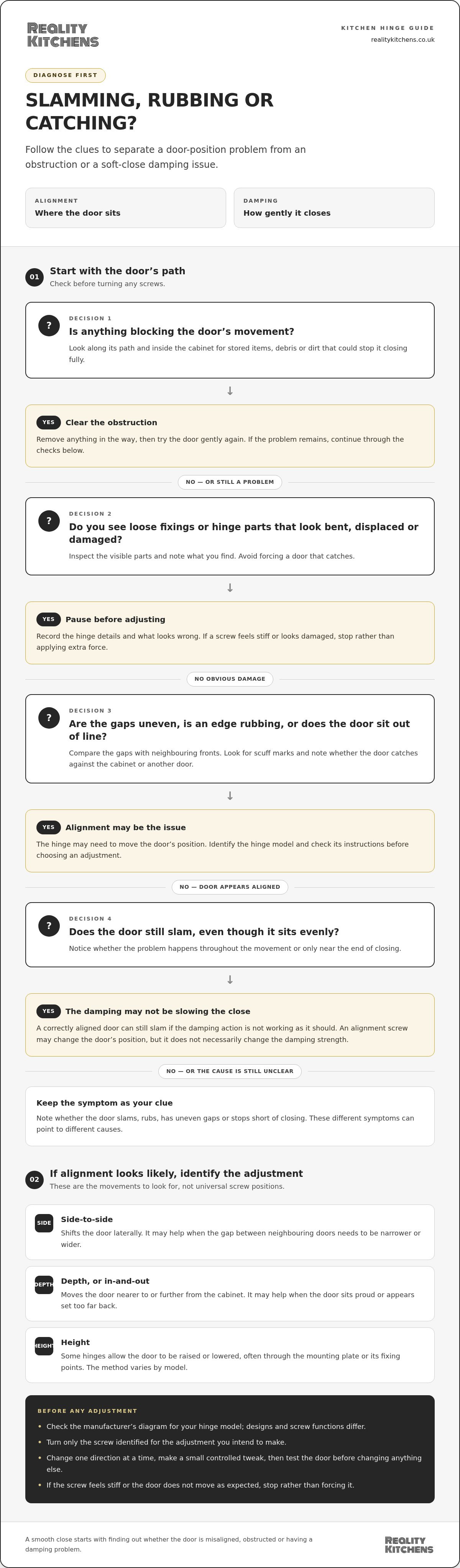
Alignment determines where the door sits; damping determines how gently it closes. A neatly aligned door can still slam if the damping action isn’t slowing it. Equally, the damping may work while a misaligned door catches on the cabinet. Separate these two issues when deciding what to inspect next.
What does a soft-close kitchen hinge do?
A soft-close hinge is cabinet hardware with a damping mechanism that slows the final part of a door’s movement, helping it approach the closed position more gently. The hinge supports and pivots the door, whilst the damper controls its closing action. Designs and damping arrangements vary between manufacturers, so don’t assume there is one universal screw layout or adjustment range.
Concealed hinges, sometimes called cup or Euro hinges, are commonly used on kitchen cabinets. For a general overview of types of hinges and their adjustability, see Wikipedia’s hinge guide. The key point when diagnosing a fault or choosing soft close kitchen hinges is to identify the hardware you have: adjustment screw positions and functions differ between designs.
What to check before adjusting a cabinet door
Start with a visual and physical check rather than turning screws straight away. Open the door and look along its path. Stored items, debris or dirt around the cabinet can interfere with movement, while something inside may prevent the door closing fully. Clear anything in the way, then try the door gently again.
- Look at the gaps. Compare the spaces around the door with those around neighbouring fronts. A gap that widens towards the top or bottom may suggest the door is sitting unevenly.
- Check the edges. Look for fresh scuff marks or rubbing where the door meets the cabinet or a neighbouring door.
- Notice how it closes. Does it slam, close smoothly or stop before it meets the cabinet? Note whether the problem occurs throughout the movement or only near the end.
- Inspect the visible fixings. Look for screws that appear loose or hinge parts that seem bent, displaced or damaged. Avoid forcing a door that catches.
These checks won’t identify every fault, but they help distinguish a door-position problem from an obstruction or a possible damping issue. Note what you observe before making an adjustment, so you have a clear starting point and can judge whether the change helps.
Which soft-close hinge screws adjust door height, depth and alignment?
Once you’ve checked the door’s movement, the next challenge is identifying the right adjustment point. Concealed kitchen hinges often have several screws, but their position alone doesn’t reliably show what each one does. A screw on the hinge arm may alter the door’s position, secure the hinge or serve another purpose, depending on the design.
Hinge adjustment changes the door’s position, but it doesn’t necessarily change the strength of the soft-close damping. If the door sits crooked, alignment may be the issue. If it is correctly positioned but still slams, turning an alignment screw may not restore the damping action.
How to recognise the common adjustment points
On a concealed hinge, the hinge arm is the moving metal section between the door and cabinet. It connects to a mounting plate, the piece fixed inside the cabinet. Use these as orientation cues, not as a universal screw guide. Designs differ, so check the manufacturer’s diagram before making a change.
- Side-to-side: This adjustment shifts the door laterally. It can make the gap between neighbouring doors narrower or wider, which may help when one edge sits closer than the other.
- Depth, or in-and-out: This moves the door nearer to or further from the cabinet. It may help if the door sits proud of the cabinet front or appears set too far back.
- Height: Some hinges allow vertical adjustment, often through the mounting plate or its fixing points. This can raise or lower the door, but the method varies between models.
These directions describe the result you’re looking for, not a guaranteed screw location. If a door’s side gap is uneven, a side-to-side adjustment may be relevant. If the door’s face doesn’t sit in line with the cabinet, depth may be worth investigating. Change one direction at a time so you can tell what effect each adjustment has.
Why hinge instructions matter
Hinge designs vary. Some provide several adjustment options, whilst others use different screw arrangements or offer a more limited range. Before turning an unfamiliar screw, find the manufacturer’s instructions or diagram for the hinge model. If you can’t identify it, note any markings and compare the hinge’s shape with the documentation rather than guessing from its position.
Turn only the screw identified for the adjustment you intend to make. If it feels stiff, looks damaged or doesn’t produce the expected movement, stop rather than applying extra force. A screw may be a fixing rather than an adjuster, and forcing it could damage the fitting or affect how securely the door is held.
Careful identification is useful beyond a single adjustment. If your kitchen’s hardware or layout needs broader consideration, bespoke kitchen planning can take everyday use and the room itself into account.
Do soft-close hinges need replacing, or is the door simply misaligned?
A door that doesn’t close smoothly doesn’t automatically need a new hinge. A change in its position, an obstruction or a loose fixing may be affecting movement, even if the damping mechanism is still working. Conversely, a door can look straight yet slam because its closing action isn’t being slowed as expected. A symptom is a useful clue, not a diagnosis on its own.
Compare what you see with what happens as the door moves. The table sets out possible causes and sensible first checks, but it can’t confirm a fault without inspecting the hinge and door.
| Symptom | Possible cause | Sensible next check |
|---|---|---|
| Uneven gaps or a door sitting proud | Possible alignment issue | Compare the door with neighbouring fronts and inspect the hinge fixings. |
| Edge rubs or catches | Possible misalignment or obstruction | Check the contact point and clear anything blocking the door’s path. |
| Door slams despite sitting evenly | Possible damping problem | Check alignment first, then consult the hinge instructions. |
| Closing action varies or feels rough | Possible loose, worn or damaged hinge parts | Inspect visible parts and use model-specific guidance. |
Signs that alignment may be the main issue
Uneven gaps, an edge that rubs or a door that sits further forward than neighbouring fronts can point to a positional problem. If the hinge parts and fixings appear sound, careful adjustment in the relevant direction may improve how the door sits. Before changing anything, check that a nearby door isn’t interfering and that cabinet contents aren’t preventing full movement. An alignment change can correct the gap without repairing a faulty damper.
Signs the closing mechanism may be damaged
If the door continues to slam or its damping feels inconsistent after you’ve checked its position, the mechanism may need closer attention. Visible damage, loose hinge parts or rough movement also warrant inspection. None of these signs alone proves the hinge is beyond repair. Consult instructions for the exact hinge model to understand whether adjustment, repair or replacement is appropriate, and stop if a component appears damaged.
Note the door’s position, where it catches and whether the closing action changes from one attempt to the next. This record helps avoid repeated, uncertain adjustments and gives you a clearer basis for deciding what to do. When choosing soft close kitchen hinges, the distinction matters: a replacement must suit the cabinet, but it won’t necessarily solve a problem caused by alignment or an obstruction.
How to adjust soft-close kitchen hinges safely, one small turn at a time
A measured approach helps you avoid turning the wrong screw or making a door sit worse. Before you begin, make sure the door’s path is clear and you can work without rushing. If the door is heavy or feels unstable, support it before adjusting the hinge. Stop if anything looks damaged or you’re unsure which part you’re handling.
Change one adjustment at a time, then close and retest the door before making another change. That way, you can see what each small adjustment has changed.
Prepare and make a small adjustment
Clear nearby items, then inspect the door edges, cabinet and visible hinge parts. Find the hinge model and use its manufacturer’s guidance to identify the correct adjustment screw. Use a screwdriver that fits the screw head properly, and keep the door supported where needed. Don’t assume a screw’s purpose from its position or force one that resists turning.
- Clear the area. Remove anything in the door’s path and make space to open and close it safely.
- Inspect before touching the screws. Look for loose fixings, rubbing marks, damaged parts or anything that could obstruct the door.
- Identify the hinge and adjustment. Check its markings or model details against the manufacturer’s diagram. Confirm which screw affects the movement you want to change.
- Make a small turn. With the door supported if needed, turn only the identified screw slightly. Don’t adjust several screws together, as you won’t know which change affected the result.
- Test before continuing. Close the door gently and check whether its position or movement has changed. Note the result before deciding whether another small adjustment is needed.
Test the door and refine the result
Open and close the door slowly, paying attention to where it moves freely and where it catches. Compare the gaps around it with those of neighbouring doors, and check whether its edges still rub against the cabinet. If the change has made movement worse, don’t keep turning the screw in the same direction. Follow the manufacturer’s instructions to assess whether to reverse the adjustment.
Stop if parts loosen, a screw becomes difficult to turn or the hinge behaves unexpectedly. Repeated changes without a clear improvement can make diagnosis harder. The issue may need a different solution rather than further adjustment.
Once the door moves as intended, leave the screws secure and check its operation again during normal use. If a damaged or worn hinge appears to need replacing, identifying the existing model and door arrangement can help inform your next step. Those details are also a useful starting point when choosing soft close kitchen hinges for a wider kitchen update. For help planning a kitchen around everyday use, explore bespoke kitchen design.
When adjustment is not enough: plan kitchen hardware around everyday use
If the door still slams, rubs or moves unreliably after careful adjustments, pause before turning another screw. Repeated changes without a clear improvement can make it harder to identify the cause, and the issue may not be alignment alone. A faulty damping mechanism may need repair or replacement suited to that hinge model.
What to do when the door still does not close properly
Return to the basics: check that nothing obstructs the door, compare its alignment with neighbouring fronts, and look for loose fixings or visible damage. Revisit the hinge maker’s instructions to ensure you’ve used the correct adjustment point and method. Don’t force damaged parts or keep turning the same screw if the door’s behaviour hasn’t improved.
Write down any markings or model details on the hinge and describe what happens. Note whether the door slams, catches, stops short or closes inconsistently, and whether you’ve already checked its position. These observations help distinguish a potential mechanism fault from an obstruction or alignment issue, without assuming that one symptom proves the hinge is damaged.
If a mechanism appears faulty, use the model-specific guidance to understand whether repair or replacement is appropriate. Avoid choosing a substitute based on appearance alone; the hinge needs to suit the door and cabinet arrangement. If you’re choosing soft close kitchen hinges as part of a wider refresh, clear details about the existing fitting and the problem can help inform the component choices.
Make hardware part of a considered kitchen plan
Hinges are small components, but their reliable movement contributes to how comfortably you use the kitchen every day. Door action, clearances and the finish of cabinet fronts all form part of a room that feels cohesive and works well. If you’re reviewing more than one fitting or planning changes to the room, bespoke kitchen design in Northwich can be considered alongside the wider layout and your home’s needs.
For a complete project, cabinetry and other components should be considered as part of the same practical plan, rather than in isolation. Reality Kitchens provides personalised bespoke kitchen design and supplies kitchen components, appliances and worktops, working alongside trusted builders and installers to deliver the final kitchen. Planning is shaped around your home and how you use it.
If a wider kitchen refresh is on your mind, explore a bespoke kitchen design and consider how the details can work together for everyday use.
Make the next kitchen decision with confidence
A smoothly working door is part of a kitchen that feels considered in everyday use. If a recurring hinge problem has prompted you to think beyond a quick adjustment, consider how the room’s components work together, from storage and access to the overall finish. That wider perspective can make choosing soft close kitchen hinges part of a more thoughtful kitchen plan, rather than an isolated decision.
Reality Kitchens offers personalised bespoke kitchen design, including visits to customers’ homes, to plan around the space and how they use it. Supplied kitchen products are backed by a ten-year guarantee. Reality Kitchens works with homeowners in Northwich, Hartford, Weaverham, Winnington, Davenham, Knutsford, Cranage, Goostrey, Holmes Chapel, Tarporley, Helsby, Frodsham, Sandiway, Cuddington, Comerbach, Altrincham, Hale, Bowdon and Ashley. To plan a wider refresh around your home, explore a bespoke kitchen design tailored to your needs.
Frequently Asked Questions
Is every soft-close kitchen hinge adjustable?
No, adjustment options vary by hinge model. Some hinges allow you to reposition the door, whilst the damping action may not have a separate adjustment. Look for a maker’s mark or model number and compare the fitted hinge with the manufacturer’s instructions before deciding a screw is missing. A hinge without a particular adjustment screw isn’t necessarily faulty; its design may simply use a different arrangement or offer fewer adjustment options.
Can I adjust a soft-close kitchen hinge without removing the door?
Often, positional adjustments can be made with the door still fitted, but access depends on the cabinet and hinge design. A neighbouring door or a tight corner, for example, may limit room to reach the hinge comfortably. If the door feels unstable, support it before working. Make one small change, then open and close it carefully to assess the result. Don’t assume every hinge can be adjusted safely in place.
Why does my soft-close kitchen door still slam after adjustment?
A door may still slam if you’ve turned a screw that changes its position rather than its damping, or if the mechanism is damaged. Loose fixings or something interfering with the door’s path are other possibilities. Before making another adjustment, compare the hinge with its model-specific instructions and inspect the door’s movement. If its alignment appears sound but the closing action remains unreliable, further adjustment may not solve the problem.
How do I know which screw adjusts a soft-close hinge?
There’s no universal rule for identifying an adjustment screw by its position. Find the hinge’s model details, then compare the fitted hardware with the manufacturer’s diagram. Check that the diagram shows the same hinge arrangement, rather than relying on a similar-looking fitting. Avoid turning screws at random, as one may secure a component rather than adjust it. If the instructions identify the correct setting, make a slight change and observe the door.
Can I adjust how quickly a soft-close kitchen door shuts?
Some hinge models may allow damping adjustment, but others don’t have a separate speed control. Positional screws generally move the door rather than change how the damping works. Check the instructions for your specific model to see whether closing speed can be adjusted and how. If no speed adjustment is documented, don’t force a mechanism or experiment with unrelated screws; the slamming may have another cause that needs investigating.
When should I replace a soft-close kitchen hinge instead of adjusting it?
Replacement may be appropriate if the hinge or damping mechanism is visibly damaged, parts remain loose, or the closing action still fails after correct model-specific adjustment. First inspect the door and cabinet, since persistent misalignment can have another cause. When choosing soft close kitchen hinges, match any replacement to the existing fitting and cabinet requirements, not appearance alone. For homeowners in Northwich and nearby areas, the kitchen’s layout can also shape which components suit a wider update.


