

The true measure of modern kitchen luxury isn't how pristine your cabinetry looks on installation day; it's how little effort it takes to keep it that way five years down the line. If you've ever spent an evening scrubbing stubborn cooking grease out of intricate panel recesses or buffing sticky fingerprints off dark surfaces, you already know the frustration of delicate joinery. Choosing low maintenance kitchen cabinets should liberate your time, not trap you in an exhausting cycle of wiping, polishing, and worrying about chipped paint or peeling edges.
You don't need to sacrifice bespoke elegance just to achieve everyday practicality. In this 2026 guide, you will discover the most durable materials, resilient finishes, and clever door profiles that keep your kitchen looking immaculate with minimal effort. We examine the genuine performance differences between modern laminates, sealed timbers, and anti-fingerprint coatings, whilst providing a straightforward checklist to help you invest with complete confidence.
Key Takeaways
- Learn why investing in low maintenance kitchen cabinets relies on non-porous surface science and durable substrates rather than endless daily scrubbing.
- Compare leading finishes, from High-Pressure Laminate to anti-fingerprint acrylics, to identify which options genuinely resist grease, smudges, and micro-scratches.
- Discover how door geometry dictates your cleaning routine, and why flat slab or slim-profile designs eliminate traditional dirt traps.
- Master the five essential construction benchmarks, including PUR waterproof edge-banding and wipe-clean interior carcases, before finalising your order.
- Understand the practical advantage of testing material swatches directly within your own home lighting rather than relying on artificial retail showroom displays.
Understanding Low Maintenance Kitchen Cabinets: Why Material Science Outperforms Upkeep
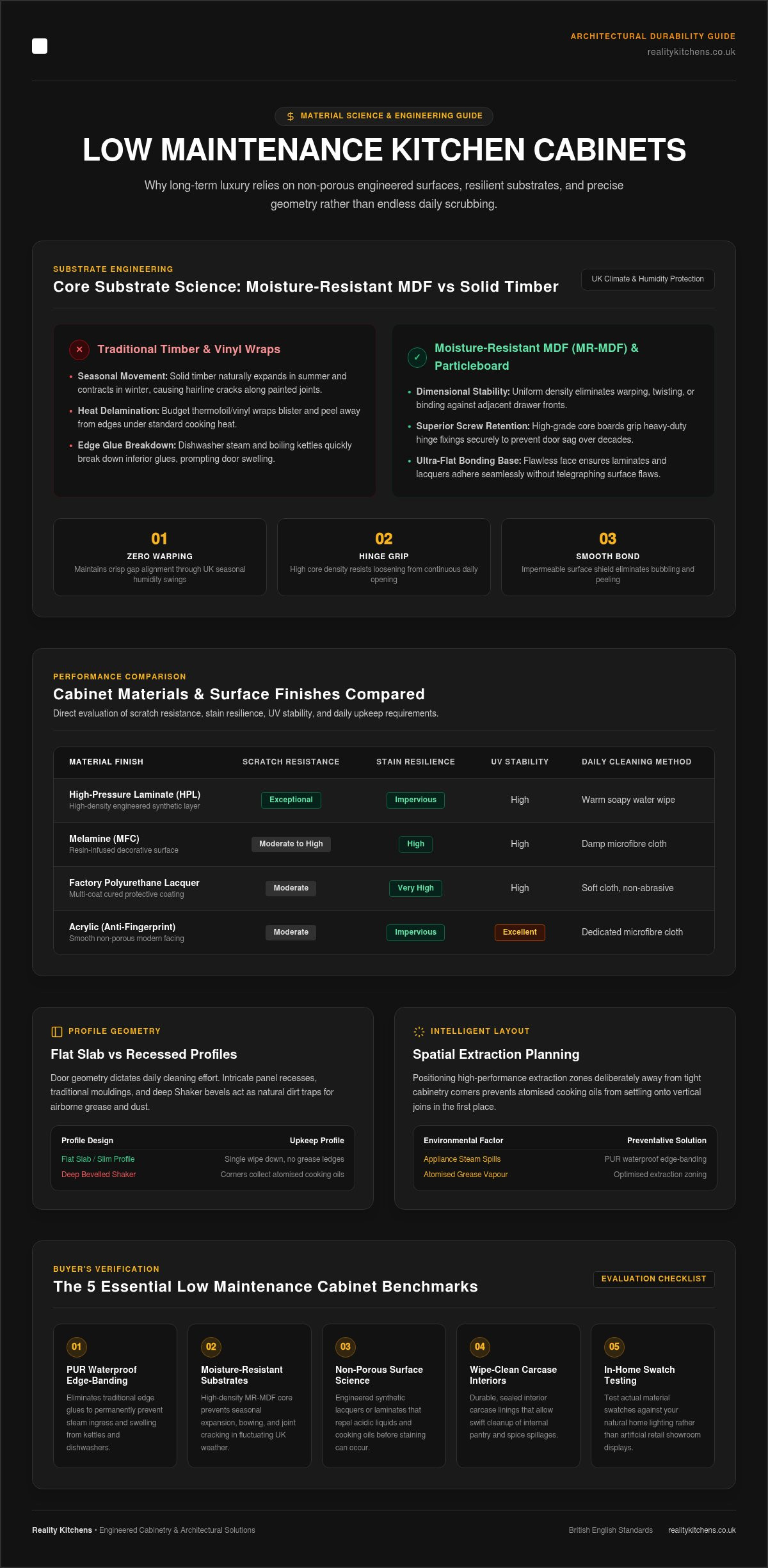
True kitchen durability is rooted in material science, not how rigorously you scrub. Genuinely low maintenance kitchen cabinets rely on non-porous external layers fused over stable substrates. These surfaces are engineered specifically to repel grease splatters, acidic spillages, and airborne steam before staining occurs. The genuine payoff is a practical lifestyle dividend; you spend your evenings enjoying your home and entertaining guests, rather than systematically buffing door faces with specialised cleaning sprays.
Many homeowners make the mistake of opting for off-the-shelf budget foil or thermofoil wraps. While these vinyl wraps present an initially smooth face, they remain notorious for delaminating, blistering, and peeling away from edges when exposed to normal cooking heat. Modern high-pressure laminates and engineered lacquers, by contrast, create an impermeable shield. Incorporating intelligent spatial planning also matters; positioning high-performance extraction zones deliberately away from tight cabinetry corners prevents atomised cooking oils from settling onto vertical joins in the first place.
The True Cost of High-Maintenance Cabinetry
Living with delicate joinery quickly becomes a full-time chore. Soft timber frontages finished in basic eggshell require constant touch-up paint to conceal everyday micro-scratches, scuffs from footwear, and edge chips. Daily environmental stresses compound this damage. Escaping steam from dishwashers, boiling kettles, and high-heat oven cycles swiftly breaks down inferior edge glues, causing visible swelling. Investing in engineered, resilient cabinetry protects the architectural integrity and resale value of your property, avoiding costly door replacements after only a few years of domestic use.
Core Substrates: High-Density Particleboard vs Engineered MDF
What lies beneath the decorative finish matters just as much as the outer coating. In the context of British cabinet construction and materials, UK homes experience substantial seasonal humidity swings. Solid timber doors naturally expand across summer and contract during winter, which frequently creates unsightly hairline cracks along painted joints.
High-density, moisture-resistant medium-density fibreboard (MR-MDF) and precision-engineered particleboards eliminate that structural movement. They offer distinct structural advantages for busy households:
- Dimensional stability: Uniform density prevents doors from bowing, twisting, or binding against adjacent drawer fronts.
- Superior screw retention: High-grade core boards grip heavy-duty hinge fixings securely, preventing sagging doors over decades of continuous opening.
- Smooth bonding base: An ultra-flat engineered face ensures modern anti-fingerprint laminates and hard-wearing lacquers adhere seamlessly without telegraphing surface flaws.
Selecting the correct core substrate ensures your low maintenance kitchen cabinets retain their crisp alignment and pristine visual appeal without constant hinge adjustments.
Cabinet Materials and Finishes Compared: Durability, Fingerprints, and Cleaning
Selecting the right surface finish dictates whether your kitchen retains its showroom polish or demands constant attention. Independent university research on cabinet materials confirms that engineered synthetic layers consistently outperform standard timber in moisture resistance and cleanability. To build genuinely low maintenance kitchen cabinets, you must match the finish to your household's daily cooking habits.
| Material | Scratch Resistance | Stain Resilience | UV Stability | Daily Cleaning |
|---|---|---|---|---|
| High-Pressure Laminate (HPL) | Exceptional | Impervious | High | Warm soapy water wipe |
| Melamine (MFC) | Moderate to High | High | High | Damp microfibre cloth |
| Factory Polyurethane Lacquer | Moderate | Very High | High | Soft cloth, non-abrasive |
| Acrylic | Moderate | Impervious | Excellent | Dedicated microfibre cloth |
| Painted Solid Wood | Low to Moderate | Moderate | Prone to fading | Careful gentle washing |
High-Pressure Laminate (HPL) and Melamine Performance
Modern HPL utilises multiple resin-impregnated kraft paper sheets compressed under intense heat. This process produces an impenetrable barrier that resists acidic spills, scuffs from wayward cooking pans, and busy family foot traffic. Advanced synchronised-pore laminates convincingly replicate authentic oak or walnut grain, giving you organic warmth without the oiling, waxing, or vulnerability of raw timber.
Anti-Fingerprint Super-Matte vs High-Gloss Finishes
Homeowners often assume dark matte finishes trap grease. While budget foils certainly hold onto finger marks, cutting-edge thermal laminates use nanotech coatings that diffuse light and actively repel natural skin oils. High-gloss finishes bounce natural light through bright garden extensions, but they reveal smudges instantly. They also require soft microfibre cloths to avoid fine surface swirls over time.
Factory-Applied Polyurethane Lacquer vs Hand-Painted Timber
Factory-cured polyurethane lacquers envelop cabinet doors in an unbroken, airtight seal. Unlike hand-painted timber doors where brushstrokes trap dust and hairline fissures let steam penetrate, multi-coat factory finishes cure completely flat. They resist yellowing from sunlight and protect vulnerable sink runs. Pairing these durable frontages with resilient kitchen worktops Northwich renovators trust ensures seamless longevity. For tailored material advice, reviewing physical samples at home with Reality Kitchens helps identify the perfect balance between style and resilience.
Door Profiles and Hardware: Eliminating Dirt Traps and Grease Catchers
While material resilience stops stains penetrating, door geometry dictates how many minutes you spend wiping down surfaces each week. Elaborate mouldings, multi-tiered profiles, and beaded frames create horizontal ledges where atomised cooking fats naturally settle and bond with ambient dust. Choosing truly low maintenance kitchen cabinets means evaluating the physical contours of every door, drawer front, and handle.
Flat Slab Doors: The Pinnacle of Effortless Cleaning
Flat slab frontages offer unmatched cleaning efficiency. Without recesses, grooves, or corner joins, maintenance requires nothing more than a single, fluid wipe with a damp microfibre cloth. Edge-banding precision plays a central role here; high-grade perimeter joins create an unbroken transition from the face to the sides, ensuring grime cannot lodge along door edges. Their clean geometry suits modern open-plan spaces, providing a quiet, architectural backdrop that keeps daily maintenance negligible.
The Modern Slim Shaker: Classic Character Without Deep Grooves
If your home demands heritage warmth rather than stark minimalism, you don't have to surrender practical upkeep. Traditional designs often feature deep, right-angled recesses that catch crumbs and cooking splatter. Modern interpretations solve this compromise. By narrowing the frame rail to just 12 to 20 millimetres and softening internal joins, slim profiles minimise dirt accumulation. Exploring the bespoke shaker kitchen shows how these refined proportions preserve classic British charm whilst shedding high-maintenance dust ledges.
Handles vs Handleless: Evaluating Practical Ergonomics
Opening mechanisms heavily influence surface hygiene. Many homeowners gravitate toward sleek handleless designs without assessing how they perform during daily food preparation:
- True handleless rails: Continuous aluminium channels recessed behind doors allow smooth access without touching the front face. However, horizontal rails beneath worktops can catch stray crumbs and require occasional vacuum nozzle passes.
- Integrated J-pulls: Scooped channels routed into the top of doors frequently collect crumbs and grease, proving trickier to wipe clean than flat surfaces.
- Push-to-open latches: While eliminating hardware entirely, these mechanisms require direct hand contact on the door face, concentrating oily smudges in high-touch zones over time.
For high-traffic family homes, external hardware often delivers superior practicality. Selecting tactile bar handles in brushed brass, matt black, or antique bronze prevents fingertips from ever touching the cabinet face. Unlike polished chrome, these textured finishes naturally conceal water marks and surface smudges between weekly cleans.
The Low Maintenance Cabinet Evaluation Checklist: Five Rules for Buyers
Investing in new cabinetry should liberate your routine, not introduce fragile surfaces that demand constant coddling. When evaluating potential suppliers, looking beyond glossy brochures is essential. True build quality reveals itself in construction specifications, edge treatments, and mechanical hardware. Use this five-point framework to assess whether a proposed design will genuinely deliver low maintenance kitchen cabinets built to withstand decades of busy family living.
- Inspect edge-banding technology: Prioritise PUR (polyurethane) or laser-welded bonding over cheap EVA glue.
- Verify internal carcase construction: Demand durable, non-porous melamine interiors rather than raw veneers or absorbent paper foils.
- Demand heavy-duty movement hardware: Ensure drawer runners and hinges carry high dynamic load ratings with integrated soft-close damping.
- Review integrated appliance venting: Confirm heat shields and passive ventilation channels protect flanking fascias from hot air and condensation.
- Insist on a ten-year guarantee: Ensure long-term manufacturer backing covers both supplied cabinetry and internal hardware mechanisms.
Seamless Edging: Preventing Delamination and Water Ingress
Edge failure remains the leading cause of early cabinet demise. Traditional EVA hot-melt adhesives leave a visible seam that softens when exposed to steam from boiling kettles or vented dishwashers. Over time, that glue line discolours and allows moisture to penetrate the core board. PUR adhesives create a chemical cross-link that repels hot steam completely, whilst laser edging fuses the protective strip directly to the board face with zero visible join. Always examine physical door edges under direct light during your design consultations to verify an unbroken seal.
Internal Cabinet Linings and Drawer Organisation
Maintenance doesn't stop at external fascias; internal cupboards must handle spills gracefully. Porous, plain white paper linings soak up leaked cooking oils and balsamic vinegar, leaving permanent dark rings. Specify textured resin or wipe-clean linen-effect melamine that cleans instantly with a damp sponge. Pair this with double-walled metal drawer boxes featuring sealed bases to contain loose spices. Achieving a clean, uncluttered look also involves clever integration, as demonstrated in our guide to integrated kitchen appliances Northwich homeowners use to eliminate dirty gaps around freestanding units.
Appliance Placement to Shield Cabinetry
Careless kitchen layouts quickly compromise even resilient materials. Ovens installed without side-deflector heat shields direct bursts of 200°C air onto adjacent doors, eventually scorching laminates. High-capacity extraction units are equally vital, pulling greasy vaporised oils out of the room before they settle on upper wall units. Balancing these technical engineering details requires careful financial planning. Reviewing realistic pricing via our breakdown of bespoke kitchen cost Cheshire guides allows you to invest where durability counts most. To evaluate hard-wearing door samples and robust hardware in your own home, book an in-home design consultation with Reality Kitchens.
Designing Hassle-Free Kitchens: The In-Home Reality Kitchens Approach
Achieving effortless upkeep requires more than just picking hard-wearing materials from a catalogue; it demands an intimate understanding of how your family interacts with space. Reality Kitchens brings bespoke kitchen design, cabinetry, premium worktops, and integrated appliances directly to Cheshire homeowners. By completely eliminating the steep overheads of running brick-and-mortar retail studios, we supply luxury, German-engineered specifications at genuinely accessible prices. Every bespoke installation is built for long-term peace of mind, backed by a comprehensive ten-year guarantee across all supplied cabinetry, components, and hardware.
Testing Cabinet Finishes in Your Natural Home Environment
Retail showrooms use highly calculated, artificial spotlighting that masks how finishes actually behave in domestic settings. We bring physical sample doors, anti-fingerprint laminates, and worktop swatches straight into your kitchen. This allows you to evaluate how different finishes handle grease marks, reflection, and daily handling under your home's unique light levels. You can see precisely how direct sunlight from bi-fold doors or warm evening pendants affect matte surfaces before making a financial commitment. Discovering the practical advantages of bypassing high-street premises is explored fully in our guide to bespoke kitchen design Northwich homeowners recommend.
End-to-End Project Delivery Across Cheshire
We work across Northwich, Knutsford, Hartford, Altrincham, Hale, and surrounding communities. Designing low maintenance kitchen cabinets works best when the entire process is managed cohesively from start to finish:
- Direct lifestyle assessment: We measure your existing space and assess high-traffic zones during the consultation, ensuring hard-wearing materials sit where family wear is heaviest.
- Expert local craftsmanship: Installation is coordinated through our established network of trusted local trades, ensuring precision alignment and flawless PUR edge sealing.
- Single point of contact: From initial CAD concepts to final commissioning, you avoid the miscommunication often found with subcontract marketplaces.
Transforming your home should be an inspiring journey rather than a stressful management task. You can discover the complete path from initial concept to finished living space in our guide to dream kitchen design. If you are ready to design a beautiful cooking space that stays spotless with minimal effort, Book your free in-home design visit with Reality Kitchens today.
Bring Effortless Living to Your Cheshire Home
Creating a kitchen that stays immaculate shouldn't feel like a never-ending chore. By combining non-porous engineered surfaces, streamlined door geometry, and moisture-tight PUR edge bonding, you invest in joinery that actively resists the chaos of daily family life. Prioritising genuine build quality ensures your low maintenance kitchen cabinets remain just as striking in ten years as they look on installation day.
At Reality Kitchens, we believe homeowners shouldn't have to pay an inflated premium for exceptional craftsmanship. By eliminating expensive showroom overheads, we deliver luxury specifications, durable worktops, and premium components straight to your door at realistic prices. Every bespoke installation across Northwich, Knutsford, and wider Cheshire is backed by our comprehensive ten-year guarantee, giving you complete confidence in the longevity of your space.
Ready to reclaim your time and enjoy a cooking environment tailored to the way you truly live? Book your free in-home bespoke kitchen design consultation today, and let's craft a home that makes daily upkeep completely effortless.
Frequently Asked Questions
Which kitchen cabinet finish is the easiest to keep clean on a daily basis?
High-pressure laminate (HPL) with an anti-fingerprint surface is the easiest cabinet finish to maintain. Its non-porous resin face prevents cooking grease, acidic fruit juices, and sauces from penetrating into the core material. Routine maintenance requires nothing more than a quick wipe using warm water, mild washing-up liquid, and a clean microfibre cloth, completely eliminating the need for specialist waxes or chemical polishes.
Are matte or gloss cabinets better for resisting noticeable fingerprints?
Modern super-matte finishes with integrated nanotech coatings resist fingerprints far better than gloss. While high-gloss doors reflect bright light and immediately highlight oily handprints, premium matte surfaces actively disperse light and repel skin oils. However, budget matte vinyls without anti-fingerprint properties can trap oil stubbornly, so choosing an engineered thermal laminate or high-grade lacquer is essential for busy areas.
Can painted timber cabinets ever be considered truly low maintenance?
Painted timber cabinets rarely qualify as low maintenance kitchen cabinets because natural wood remains vulnerable to domestic wear. Timber constantly expands and contracts as Cheshire temperatures and humidity levels shift, which often creates fine hairline fissures along joints. Soft wood profiles also chip easily around bin pulls and dishwashers, demanding regular touch-up painting and careful, non-abrasive cleaning to prevent moisture damage.
How do I clean anti-fingerprint and super-matte cabinet doors effectively?
Clean super-matte surfaces using a soft microfibre cloth dampened with warm water and a small drop of pH-neutral detergent. Wipe across the door face with light, circular motions, then dry immediately with a clean cloth to prevent water pooling. Never use abrasive scrubbing pads, bleaching agents, or harsh solvent sprays, as these degrade the microscopic surface texture that repels oils.
Why do some foil-wrapped kitchen cabinet doors peel near ovens and kettles?
Foil-wrapped doors peel because entry-level manufacturers rely on low-melt EVA adhesives that break down under continuous exposure to heat and moisture. When boiling kettles, dishwashers, or ovens vent steam against adjacent units, the glue softens and pulls away from the substrate. Specifying cabinetry built with PUR waterproof adhesives or laser-fused edging creates an impenetrable barrier against intense thermal shock.
What is the most durable door profile for busy family homes with children or pets?
Flat slab doors are the most resilient profile for high-traffic households. Without recessed grooves, routed mouldings, or raised ledges, there are no physical corners where spilt drinks, dust, or sticky residues can settle. Paired with hard-wearing PUR edge banding, slab frontages deflect accidental scuffs from toys, vacuum cleaners, and pets whilst remaining fast and effortless to wipe down.
How does Reality Kitchens ensure cabinets last without requiring extensive maintenance?
Reality Kitchens designs bespoke kitchens using heavy-duty, moisture-resistant carcases and premium engineered fascias sourced directly from trusted manufacturers. By bringing sample swatches straight to your home across Northwich, Knutsford, and wider Cheshire, we assess real lighting and family routines before building. Every kitchen component, worktop, and cabinet installation is backed by a ten-year guarantee, delivering enduring resilience without demanding retail showroom markups.


