

Corian’s greatest strength is its seamless, customisable finish; its main trade-off is the need to protect it from heat and scratches. The pros and cons of Corian worktops depend on how you use your kitchen: the non-porous surface is easy to clean, and many light scratches can be buffed away, but hot pans can scorch or damage it. Use a trivet and chopping board as everyday safeguards.
If you want a sleek, continuous surface, Corian can be joined seamlessly and shaped to include an integrated sink. Its repairability and design flexibility are practical advantages, while its lower heat resistance than quartz matters if you cook frequently. This comparison explains how Corian measures up against other kitchen surfaces, what care it needs, how heat affects it and how to choose colours and finishes for a modern kitchen.
Key Takeaways
- Weigh Corian’s repairable surface and easy-care qualities against its susceptibility to scratches and chips before choosing it over stone.
- Protect Corian from hot cookware with a trivet or heat-resistant pad, and consider how your cooking habits affect your choice.
- Compare materials by the features that matter most in your kitchen, from seamless joins and integrated sinks to scratch and stain resistance.
- Explore how colour, texture and shaping can bring a modern design together, then consider the worktop as part of your wider kitchen plan.
What are the pros and cons of Corian worktops?
Corian is a non-porous solid surface material, valued for easy cleaning and seamless design, but it can scratch, chip and suffer heat damage. Measurement, fabrication and installation involve templating the fitted kitchen, shaping the material to the required dimensions and cut-outs, then fitting the finished sections.
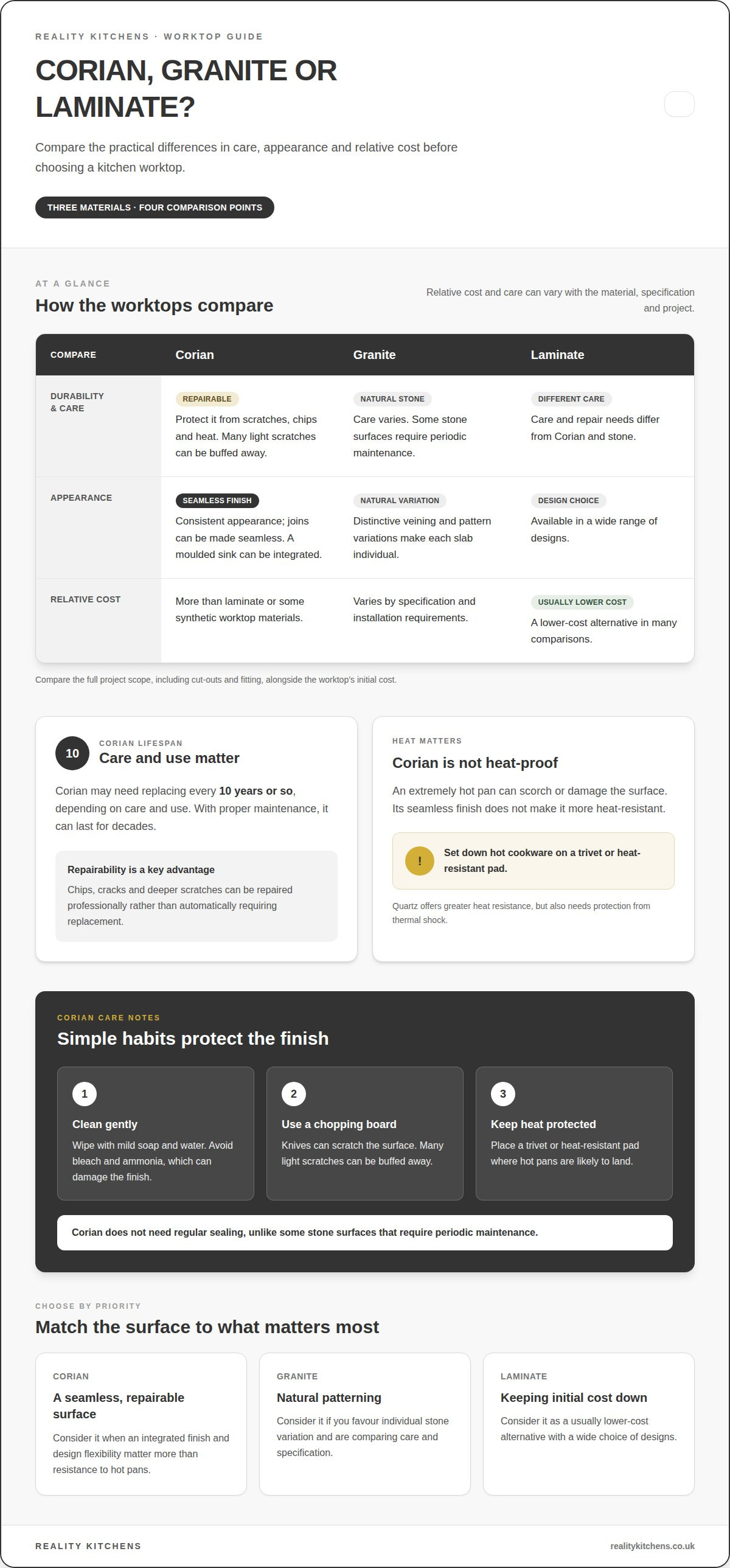
| Worktop | Durability and care | Appearance | Relative cost |
|---|---|---|---|
| Corian | Repairable; protect from scratches | Seamless, consistent finish | More than laminate or some synthetics |
| Granite | Natural stone; care varies | Distinct natural patterning | Varies by specification |
| Laminate | Different care and repair needs | Wide range of designs | Usually a lower-cost alternative |
Expected lifespan against stone
Corian may need replacing every 10 years or so, depending on care and use, but can last for decades with proper maintenance. Natural stone worktops such as granite are chosen for durability, though their lifespan depends on the stone, installation and use. Corian’s advantage is repairability; chips, cracks and deeper scratches can be repaired professionally rather than automatically requiring replacement.
Maintenance and durability
For daily care, wipe Corian with mild soap and water. Avoid harsh chemicals such as bleach or ammonia, which can damage its finish. Use a chopping board because knives can scratch the surface. Many light scratches can be buffed away, though quartz is more scratch-resistant. Corian does not need regular sealing, unlike some stone surfaces that require periodic maintenance.
Appearance against natural stone
Corian has a consistent appearance and can be joined seamlessly, making long runs look continuous. Natural stone has individual veining and pattern variations, so every slab looks distinctive. Corian can also incorporate a moulded sink, avoiding a separate join between the sink and worktop. Choose it if you prefer a uniform, integrated finish; choose granite if you favour natural variation.
Cost against alternatives
Corian can cost more than laminate or some other synthetic worktop materials. Its repairability and seamless design may be worth considering if these features matter more than the lowest initial outlay. Granite costs depend on its specification and installation requirements, so compare the full project scope, including cut-outs and fitting. The right choice balances appearance, maintenance and durability with your kitchen budget.
Choose Corian for a seamless, repairable surface, granite for natural patterning, or laminate if keeping the initial cost down is your priority.
Are Corian worktops heat‑resistant?
No. Corian is not heat-resistant, and direct contact with an extremely hot pan can scorch or damage its surface. Use a trivet or heat-resistant pad as a barrier between cookware and the worktop.
Hot-pan sensitivity
Placing a pan straight from the hob onto Corian risks heat damage. Before cooking, put a trivet or heat-resistant pad in the landing space beside the hob, ready for hot cookware. A seamless finish does not make the material more heat-resistant: the joints may be less visible, but the surface remains vulnerable to hot pans.
Scorching risk and heat resistance
Extremely hot pots and pans can scorch Corian, so do not treat it as heat-proof. Quartz offers greater heat resistance, but it also needs protection from thermal shock. Laminate is another option, but materials differ, so a similar appearance does not mean identical heat performance. Corian’s wide range of colours does not change its response to heat.
Heat resistance and chemical resistance are separate considerations. Harsh chemicals such as bleach or ammonia can damage Corian’s finish, so avoid using them on the surface. Using a trivet to guard against hot pans and choosing suitable cleaning products address different risks; neither precaution replaces the other.
Trivets and heat precautions
Make a trivet or heat-resistant pad part of your cooking routine. Put it where you plan to set down a hot saucepan, oven dish or frying pan, rather than resting cookware on Corian while you look for protection. Heat shields above dishwashers or warming drawers can also deflect rising heat and steam. These precautions help protect the worktop without changing its colour or smooth finish.
If you’re weighing heat tolerance alongside appearance and layout, explore kitchen worktop options as part of your kitchen design.
Choosing a worktop for a modern kitchen
Choose a kitchen surface by weighing hygiene, shape, appearance and everyday use. Corian suits designs where a smooth, adaptable solid surface is a priority.
Non-porous surface and hygiene
Corian’s non-porous surface is easy to clean and has fewer places for bacteria to hide than porous materials. Regular wiping helps manage everyday cooking spills, including splashes around food preparation areas. This supports a tidy kitchen but does not replace normal cleaning. Consider how often you cook and whether straightforward surface care suits your routine.
Suitability for kitchen countertops
As a kitchen worktop, Corian combines a continuous finish with design flexibility. Seamless joins can create an uninterrupted work area, while thermoforming allows the material to be shaped when heated. Unlike rigid quartz, Corian can suit curved details in a bespoke design. Its sensitivity to heat remains a drawback for cooks who often set down hot pans.
For a modern kitchen, start with the layout: identify preparation zones, the hob and sink, then consider how the worktop connects them. A seamless surface can make a compact kitchen feel visually calm, while a shaped edge can soften an island or peninsula. Corian’s adaptability supports these choices without limiting every kitchen to a straight-edged design.
Compare each material with the look and practical demands of your preferred style. Quartz offers excellent stain resistance, but its rigidity limits curved forms, and joins can show across long runs. Corian suits designs where smooth transitions and bespoke shapes take priority. Natural stone brings distinctive variation, while Corian provides a more consistent appearance across connected surfaces.
Before choosing, rank what matters most: easier cleaning, natural patterning, stain resistance or freedom to shape the design. Then match those priorities to your kitchen layout and cooking habits. Corian’s non-porous surface and formability make it an option to consider for contemporary worktops, particularly when a continuous, tailored finish is central to the design.
Colour, finish and customisation options
Corian offers a broad palette for coordinating kitchen worktops with cabinetry, flooring and lighting. Colour and finish shape the room’s character as much as the worktop’s practical features.
Colour and pattern options
Corian comes in a wide range of colours and patterns, from quiet, minimalist tones to more expressive designs. Selected colours contain between 6% and 20% recycled material, offering another factor to consider when comparing options. Look at samples beside your cupboard fronts and flooring, rather than choosing a colour in isolation. Natural stone has unique veining, whilst Corian provides a more consistent pattern across connected surfaces.
Finish customisation
Textured finishes offer another way to tailor the worktop’s appearance. A restrained finish can complement flat-fronted cupboards in a minimalist kitchen, while more pronounced texture adds contrast to plain cabinetry. Corian can also be thermoformed into different shapes when heated, supporting bespoke details beyond a standard straight run. It offers fewer edge-profile options than natural stone, so consider your preferred edge before deciding.
Consider how daylight and kitchen lighting affect the colours you compare. View samples near a window and beneath the lights used over the worktop; a pale shade may look different from morning to evening. This helps you judge whether the finish suits your room, rather than relying on a small sample viewed elsewhere.
Light and dark options each create a distinct visual effect. Choose a shade that works with your cabinets and overall scheme, then weigh its appearance against Corian’s drawbacks, including sensitivity to scratches and hot pans. Colour does not change those practical limits, but a considered finish can make the surface feel integrated into your design.
For a considered choice, plan a worktop around your kitchen design, balancing colour, texture and the shapes you want.
Reality Kitchens: Kitchen Worktops
Reality Kitchens can help bring your preferred worktop material, colour and finish into a cohesive kitchen design. Kitchen worktops are available alongside bespoke kitchen design, components and appliances, so you can consider the surface as part of the wider room rather than in isolation.
If Corian’s seamless look appeals but its sensitivity to heat gives you pause, weigh that trade-off against how you cook and the style you want. Reality Kitchens provides bespoke kitchen design for homeowners in Northwich and surrounding areas, with home visits to discuss your requirements. The design can then reflect your kitchen and priorities.
To discuss kitchen worktops and your plans, contact Reality Kitchens.
Shape a worktop choice around your kitchen
The right surface should feel at home in your kitchen, not simply look appealing on its own. Consider how your cooking habits, preferred finish and overall layout work together. Weighing the pros and cons of Corian worktops against those priorities can help you choose a surface that suits everyday use.
Reality Kitchens can incorporate your worktop decision into a wider kitchen plan through Bespoke Kitchen Design, Kitchen Components and Kitchen Appliances. This joined-up approach helps you consider how the surface relates to cabinetry, fittings and the practical needs of the room, rather than treating it as an isolated feature.
Ready to take the next step? Contact Reality Kitchens about your worktop and start shaping a kitchen that reflects your priorities.
Frequently Asked Questions
Does Corian stain more easily than Quartz?
Quartz is known for excellent stain resistance, while Corian is non-porous and straightforward to clean. Those qualities do not mean Corian stains more easily in every situation. If spills are frequent in your kitchen, wipe them promptly and consider how much you value stain resistance compared with Corian’s seamless appearance and shaping flexibility.
Is Corian a good choice for a kitchen countertop?
Corian can suit a kitchen worktop if you value a continuous, adaptable surface and are comfortable protecting it while cooking. For example, its moulded sink option can create a cohesive look around a busy washing-up area. Consider your routine too: frequent use of hot pans or chopping directly on the worktop may make its care requirements less suitable.
What is Corian made of?
Corian is made from one third acrylic resin and two-thirds mineral filler. This composition creates a solid-surface material that can be shaped and joined for continuous-looking designs. When planning a kitchen, you can consider details such as curved sections or an integrated sink alongside the worktop’s colour and layout, rather than treating it as a simple slab.
Which Worktop Is Best for Your Home?
The best worktop depends on your priorities and how you use your kitchen. Choose quartz if stain and scratch resistance are key priorities; consider Corian for seamless joins and shaped details. Granite offers natural pattern variation, while laminate can suit a tighter materials budget. Compare these qualities with your cooking habits, preferred appearance and overall kitchen design.
What are the main pros and cons of Corian worktops?
A balanced view of Corian worktops’ pros and cons starts with the features you’ll notice every day: a non-porous surface, easy cleaning and flexible design, balanced against sensitivity to heat, scratches and chips. Its repairability can help address surface damage, but it still needs careful use. Consider whether seamless styling and adaptable shapes matter more to you than greater scratch resistance.
How durable and scratch-resistant are Corian worktops?
Corian is durable for everyday kitchen use, but it is less scratch-resistant than quartz and can be marked by knives or chipped by impacts. Use a chopping board rather than treating the surface as a cutting area. Many light scratches can be buffed away, while professionals can repair deeper marks, chips and cracks. Repairability is a practical part of its durability.


