
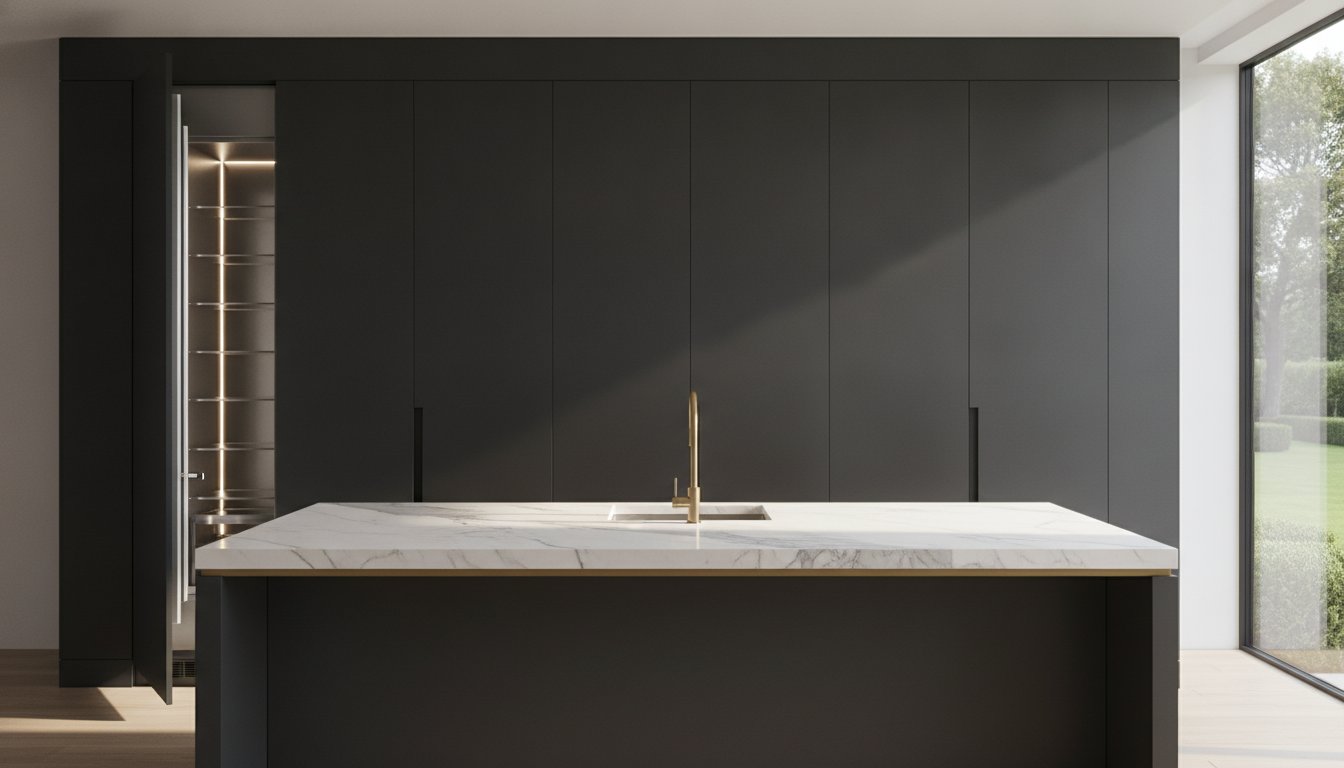
Why should your high-end kitchen design be interrupted by the jarring sight of a bulky, freestanding refrigerator or a mismatched dishwasher? When you're investing in a bespoke space, the goal is often a visually quiet environment where the architecture takes centre stage. Many homeowners searching for integrated kitchen appliances Cheshire find themselves torn between the sleek look they desire and practical fears about repair access or long-term reliability. It's a valid concern; nobody wants to dismantle beautiful cabinetry just to fix a faulty sensor.
We believe that true luxury shouldn't come with a compromise on practicality or peace of mind. You can expertly blend high-performance technology with custom cabinetry to create a clutter-free, sophisticated kitchen that feels cohesive and intentional. This guide explores how to select the most reliable brands for 2026, navigate the latest energy regulations, and position your appliances for maximum efficiency. We'll show you how to achieve an architectural finish using premium brands at realistic prices, ensuring your home remains both a functional workspace and a stunning design statement.
Key Takeaways
- Learn why hidden appliances are the cornerstone of the 2026 "visually quiet" kitchen trend across Knutsford and wider Cheshire.
- Understand the technical differences between fully and semi-integrated units to choose the right level of seamlessness for your bespoke cabinetry.
- Discover strategic positioning techniques, such as grouping refrigeration into "cool zones," to optimise your kitchen's workflow.
- Find out how to source premium integrated kitchen appliances Cheshire from brands like Miele and Siemens without paying traditional showroom markups.
- Explore why a professional home-visit approach is essential for ensuring custom panels fit with millimetre precision in your unique space.
What are Integrated Kitchen Appliances and Why Choose Them for Your Cheshire Home?
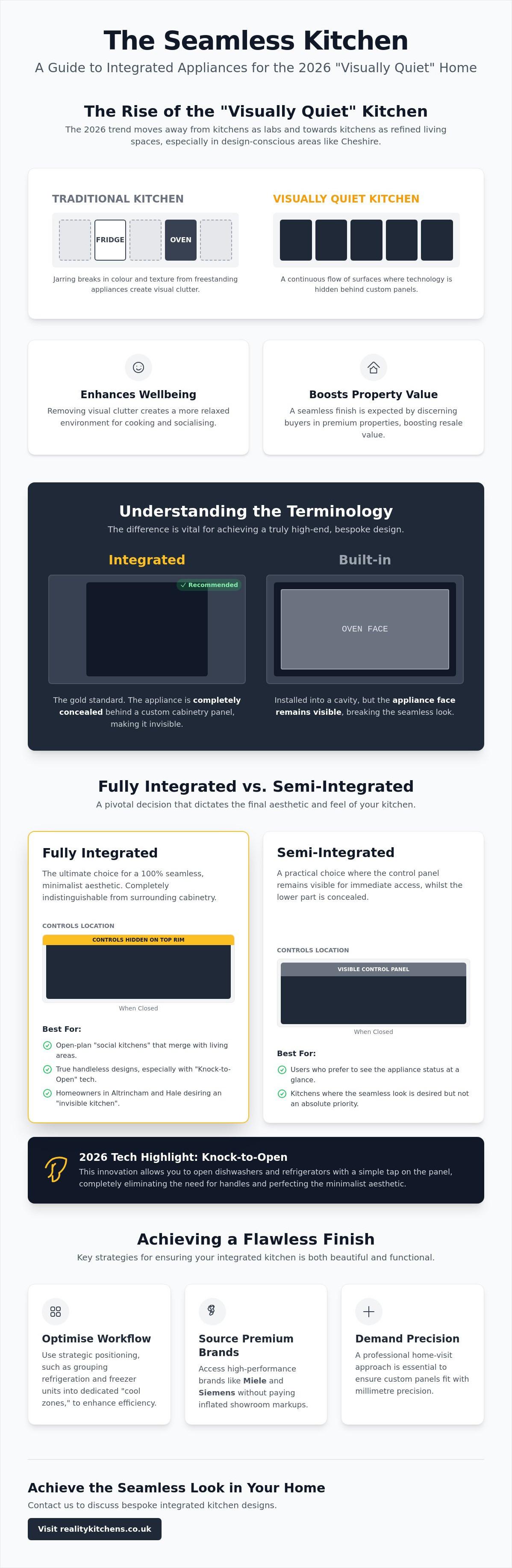
Integrated appliances aren't just gadgets; they're the invisible workhorses of a sophisticated home. Unlike standard units, these models are designed to sit flush within your units, completely hidden behind bespoke cabinetry panels. In Cheshire, specifically within the design-conscious hubs of Knutsford and Wilmslow, the 2026 trend has moved firmly toward a "visually quiet" kitchen. This minimalist, handleless aesthetic relies on integrated kitchen appliances Cheshire to maintain a continuous flow of colour and texture without the interruption of industrial-looking machinery. It's a move away from the kitchen as a laboratory and toward the kitchen as a refined living space.
There's a genuine psychological shift when you remove visual clutter. Cooking and socialising become more relaxed when you aren't surrounded by mismatched white or steel surfaces. Beyond the immediate lifestyle benefits, investing in a seamless finish significantly boosts the resale value of premium properties across the North West. Discerning buyers expect Major household appliances to be tucked away, treating the kitchen as an extension of the living space rather than a utility room. It's a practical investment that pays dividends in both daily enjoyment and long-term property equity.
The Aesthetic Advantage of Hidden Technology
By choosing to hide your technology, you eliminate the jarring visual breaks caused by traditional stainless steel or white plastic. This approach creates a furniture-like feel, which is essential for modern open-plan living. Whether you prefer the timeless appeal of bespoke painted Shaker doors or the crisp lines of contemporary slab designs, your appliance panels can be matched perfectly. It's about achieving a look where the dishwasher and fridge are indistinguishable from the surrounding storage. This creates a calm, architectural flow that makes even smaller Cheshire kitchens feel more expansive and expensive.
Integrated vs. Built-In: Understanding the Terminology
Confusion often arises between these two terms, but the difference is vital for your design. Built-in models are installed into a cavity but usually leave the appliance face visible. In contrast, a fully integrated unit is totally concealed. This is the gold standard for high-end bespoke design. When choosing integrated kitchen appliances Cheshire, you're opting for a finish where the technology vanishes entirely. Modern 2026 models have also solved historical cooling issues; they now utilise clever plinth-level ventilation to ensure high-performance motors stay cool without needing unsightly grills on the cabinetry face. This ensures longevity without compromising the sleek external aesthetic.
Fully Integrated vs. Semi-Integrated: A Comparison for 2026
Choosing between fully and semi-integrated units is a pivotal decision that dictates the final "feel" of your kitchen. A fully integrated appliance is the ultimate choice for those seeking a 100% seamless look. The control panel is hidden away on the top rim of the door, meaning the unit is completely indistinguishable from the rest of your bespoke cabinetry when closed. In contrast, a semi-integrated model allows the control panel to remain visible whilst the lower portion of the unit is panelled. This choice often comes down to how you interact with your space on a daily basis and whether you prefer an uninterrupted aesthetic or immediate access to a digital display.
The landscape of integrated kitchen appliances Cheshire has been transformed by 2026 "Knock-to-Open" technology. This innovation allows you to open a dishwasher simply by tapping the front panel, completely removing the need for handles. This tech is particularly popular in handleless, contemporary designs where a physical pull would break the clean horizontal lines of the room. When these high-performance units are combined with energy-saving behaviors, such as using eco-modes that are now standard on premium 2026 models, you achieve a kitchen that is as efficient as it is beautiful.
When to Choose Fully Integrated Units
Fully integrated units are the essential choice for "social kitchens" where the cooking zone merges directly with your lounge or dining area. This is a dominant trend in Altrincham and Hale, where homeowners often desire an "invisible kitchen" that doesn't feel like a utility space. To solve the problem of not knowing when a silent cycle has finished, modern models now use floor-projected light indicators. These discreet LEDs beam the remaining time or a simple colour status onto your floor tiles, providing all the information you need without a visible control panel in sight.
The Practicality of Semi-Integrated Designs
For busy family households, the semi-integrated design remains a practical favourite. If you frequently need to check how much time is left on a wash whilst juggling other tasks, having a visible display is a significant advantage. These units can be cleverly centred within a run of bespoke cabinetry to maintain symmetry. Many clients choose to coordinate the metal finish of the control panel with other accents in the room, such as the tap or door knobs. If you're struggling to decide which configuration best supports your routine, discussing your options during a bespoke design home visit can help you visualise how each choice impacts your daily workflow.
Strategic Design: Positioning Integrated Appliances for Optimal Workflow
A showroom floor in a retail park can't replicate the specific footprint of your home in Tarporley or Frodsham. True luxury in integrated kitchen appliances Cheshire comes from how they are positioned to support your natural movement. We revisit the traditional "Golden Triangle", the path between your fridge, sink, and cooker, but with a modern twist. When units are hidden, their placement becomes purely about spatial logic rather than visual symmetry. You aren't forced to put a fridge in a specific corner just because it's the only spot it looks right. Instead, you can group tall integrated refrigeration and larder units together to create a dedicated cool zone wall. This consolidates your food storage into one high-performance architectural block that feels like a solid wall rather than a collection of machines.
We're also seeing a rise in point-of-use refrigeration. This involves integrating drawer fridges directly into kitchen islands or prep zones. It's a pragmatic solution for families who want drinks or fresh produce within reach of the prep area without crossing the room. Similarly, positioning integrated ovens and microwaves at chest height is a non-negotiable for ergonomic design. It removes the need for awkward bending and makes transferring heavy dishes much safer. By detaching these units from the floor, we create a more comfortable environment that respects your physical well-being.
Designing the Hidden Utility Zone
In many open-plan Cheshire homes, the kitchen must also function as a laundry space. We integrate washing machines and tumble dryers behind acoustic-dampened cabinetry. This significantly reduces decibel levels, ensuring your evening socialising isn't interrupted by a spin cycle. Strategic placement is equally important for your integrated dishwasher. It should always sit adjacent to the sink and waste bin to minimise drips across the floor. Our designs ensure that whilst these units are hidden, they have the necessary plinth and carcass ventilation to maintain airflow and prevent overheating, which is essential for the longevity of the motor.
Island Integration: Hobs and Drawers
The kitchen island is often the heart of the home, but bulky extractor fans can ruin the line of sight. By using ENERGY STAR certified downdraft induction hobs, you keep the ceiling clear and the aesthetic uninterrupted. For those who enjoy entertaining in Cheshire, an integrated wine cooler is a popular addition. We ensure a consistent handleless rail profile across the entire island, so the wine cooler and drawer fridges blend perfectly with the surrounding storage. This level of detail is what separates a standard refit from a bespoke integrated kitchen appliances Cheshire project, ensuring every inch of your island is both functional and beautiful.
Sourcing Premium Brands: Performance Without the Showroom Markup
Selecting the right machinery for your home is about balancing long-term reliability with upfront value. For integrated kitchen appliances Cheshire, we prioritise premium brands like Miele, NEFF, and Siemens. These manufacturers aren't just chosen for their prestige; they're selected for their engineering excellence, particularly their precision hinges. Cheap integrated units often represent a false economy. Whilst they might save you a few hundred pounds initially, the cost of replacing a failed unit that's been built into bespoke cabinetry can be astronomical. You aren't just paying for a brand name; you're paying for the peace of mind that your appliances will last as long as your kitchen. If a budget unit fails after three years, finding a direct replacement that fits your existing custom door panels can be a logistical nightmare.
We operate a lean, home-visit model that skips the traditional high-street showroom. This allows us to source high-end appliance packages directly, passing those operational savings straight to you. By removing the overheads of a physical store, we make aspirational kitchens accessible to more homeowners in Northwich and Knutsford. We coordinate with a network of trusted local installers who understand the nuances of bespoke fitting. This ensures that every unit is installed with millimetre precision, protecting both the appliance and your cabinetry. This transparent approach is why our clients trust us to manage their entire project from initial concept to the final connection of the mains.
The Importance of Precision Hinges and Fit
Bespoke cabinetry panels are heavy. To support this weight over thousands of openings, your appliances require heavy-duty "sliding" or "fixed" hinge systems. Poor quality hinges are the primary cause of misaligned doors amongst your beautiful new units. Once a door begins to sag, it ruins the architectural lines of the entire run. As professional kitchen designers, we specify the exact appliance dimensions and hinge types required for your specific door material. This technical foresight ensures your kitchen remains as functional and aligned in ten years as it is on day one. It prevents the stress of dragging doors or unsightly gaps that detract from a premium finish.
Realistic Prices for Aspirational Kitchens
Our business model is built on transparency. We believe you should have access to the best technology without the unnecessary showroom markup. Why skipping the showroom can save you thousands is a core principle of how we work. By focusing on the design and the outcome rather than maintaining a retail space, we can offer premium integrated kitchen appliances Cheshire alongside a ten-year guarantee on our bespoke components. This approach bridges the gap between high-end luxury and practical affordability. If you're ready to see how our resourceful model can maximise your investment, you can request a personalised appliance quote as part of your design consultation.
Achieving the Seamless Look: The Reality Kitchens Home-Visit Approach
A sterile showroom display in a retail park can never replicate the unique character of your own property. It's why we start every project with a comprehensive home visit in locations like Bowdon, Davenham, or Holmes Chapel. Your kitchen doesn't exist in a vacuum; it exists within the specific light of your conservatory or the architectural quirks of a Cheshire barn conversion. By visiting you in situ, we can accurately assess how integrated kitchen appliances Cheshire will interact with your natural light and floor space. We measure the actual environment to ensure that deep integrated units won't compromise your walkways or storage ratios. This grounded approach bridges the gap between a high-end vision and a functional reality that works for your specific household.
Our process is designed to be transparent and resourceful. We act as your knowledgeable guide, navigating the technical complexities of cabinetry depths and ventilation requirements so you don't have to. During our visit, we look beyond the measurements to understand the flow of your home. We check for existing plumbing and electrical points to see if they can be optimised for your new layout. This early-stage due diligence prevents the stress of mid-project "surprises" and ensures that the sleek, architectural finish you've planned is actually achievable within your budget and timeframe.
The Personalised Design Consultation
We believe that your choice of machinery should reflect your lifestyle, not just a trend. During our personalised consultation, we discuss your favourite cooking styles to determine which specific technologies will add genuine value to your day. If you're an avid entertainer, we might explore the benefits of sous-vide drawers or steam ovens. We also analyse your refrigeration needs in detail. Some families prefer the expansive look of integrated French doors, whilst others find that separate fridge and freezer columns offer better organisation for a busy week. Visualising these options in your own space allows you to make confident decisions based on your actual habits rather than a salesperson's pitch.
From Initial Sketch to Final Installation
Once the design is finalised, we move from vision to implementation. We work alongside your chosen builders or introduce you to our network of trusted local installers who specialise in integrated kitchen appliances Cheshire. This collaboration ensures that every unit is commissioned correctly for peak performance and energy efficiency. We oversee the technical details, such as ensuring the custom panels are perfectly weighted for the appliance hinges, so your kitchen remains effortless to use. If you're ready to transform your space into a clutter-free sanctuary, you can book your bespoke home design visit in Cheshire today and take the first step toward a kitchen that is both a practical workspace and a design masterpiece.
Achieving Your Vision of a Seamless Cheshire Kitchen
The journey to a clutter-free, sophisticated home begins with understanding that true luxury is often found in what remains hidden. By choosing the right integrated kitchen appliances Cheshire, you create a "visually quiet" environment that allows your bespoke cabinetry and architectural flow to take centre stage. We've explored how prioritising precision engineering and strategic positioning ensures your space remains as functional as it is beautiful, avoiding the common pitfalls of mismatched freestanding units.
Our practical approach bridges the gap between high-end aspiration and realistic value. With our expert home-visit design service, we bring the planning process into the actual light and space of your home. You'll benefit from premium appliances at realistic prices and our ten-year guarantee on bespoke components, providing long-term peace of mind without the traditional showroom markup. It's time to move from the planning stage to a tangible result that enhances both your daily routine and your property's value.
Book your free bespoke kitchen design consultation in Cheshire and let's start crafting your perfect space today.
Frequently Asked Questions
Are integrated kitchen appliances more expensive to repair?
Repairing the internal mechanics of an integrated unit costs the same as a freestanding model. However, you might find that labour charges are slightly higher. This is because an engineer must carefully remove the decorative cabinetry panel and potentially slide the unit out of its housing to gain access. Choosing premium brands with reliable components reduces the frequency of these visits, protecting your long-term maintenance budget and peace of mind.
Do integrated appliances need special cabinets?
Yes, these units require specific appliance housing carcasses rather than standard storage cupboards. These cabinets are designed with reinforced bases to support the weight of heavy machines like washing machines or ovens. They often feature open backs or specific cut-outs to facilitate airflow. Using the correct housing ensures your appliances sit flush with the rest of your kitchen run for that seamless, high-end architectural look you're after.
Can I replace an integrated appliance with a different brand later?
You can usually swap brands as long as the dimensions match the standard UK 600mm width. It's vital to check whether your current setup uses a sliding or fixed hinge system before buying a replacement. If you switch, your installer will need to realign the mounting brackets on your bespoke door panel. We always recommend checking the manufacturer's technical drawings to ensure a perfect fit within your existing bespoke units.
Do integrated fridges and dishwashers need ventilation?
Ventilation is essential for any integrated cooling or heating appliance. Fridges, in particular, need a constant flow of air to prevent the compressor from overheating. This is typically achieved through a discreet grill in the plinth and a small gap at the top of the cabinet. Proper airflow ensures your integrated kitchen appliances Cheshire operate at peak efficiency, helping you adhere to the latest rescaled A-G energy rating standards.
What is the difference between a sliding hinge and a fixed hinge for integrated doors?
A sliding hinge uses a bracket system that allows the cabinetry door to slide across the appliance door as it opens. A fixed hinge attaches your bespoke panel directly to the appliance door itself. Fixed hinges are generally more robust and offer a wider opening angle, which is why they're often preferred for high-end bespoke kitchens. They provide a more solid feel and better weight distribution for heavy custom doors.
Are integrated appliances smaller than freestanding ones?
Integrated models are slightly smaller because they must fit inside a standard 600mm cabinet. You'll typically lose about 10% to 15% of internal capacity compared to a freestanding unit of the same external width. For example, an integrated dishwasher might hold 12 place settings instead of 14. It's a small trade-off for the significantly cleaner, more sophisticated aesthetic achieved by hiding the machinery behind your beautiful cabinetry panels.
How long do integrated kitchen appliances typically last?
Most high-quality integrated kitchen appliances Cheshire are built to last between 10 and 15 years. Brands like Miele and Siemens are engineered for longevity, provided they are installed with the correct ventilation. Regular maintenance, such as cleaning filters and checking door seals, will help your units reach their full lifespan. Investing in premium technology from the start prevents the disruption and cost of replacing built-in units prematurely.
Can I integrate a microwave or coffee machine into my kitchen units?
Integrating smaller appliances is a fantastic way to clear your worktops of visual clutter. Most manufacturers offer built-in microwaves and coffee machines designed to sit at eye level in a tall housing unit. These often come with matching trim kits to ensure they align perfectly with your oven. This creates a dedicated "chef's station" that looks intentional and professional, rather than having various gadgets scattered across your quartz surfaces.


