

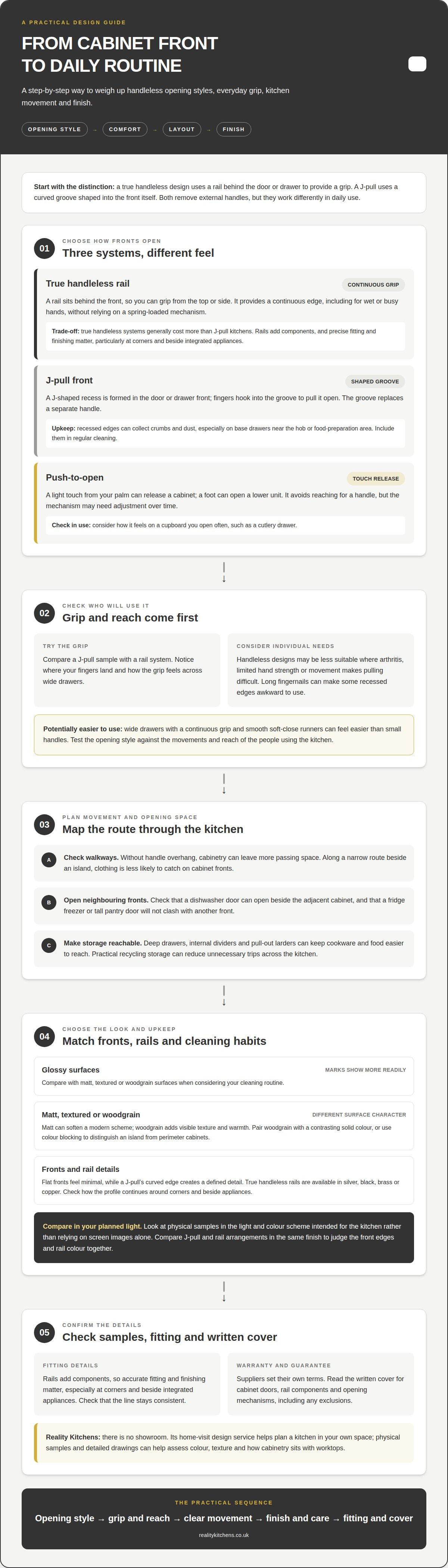
The sleek look is only half the story: handleless kitchen cabinets in Hale open through a recessed channel, a shaped door edge or a push-to-open mechanism, rather than external handles. In a true handleless design, a rail behind the door or drawer provides a grip; J-pull fronts use a curved groove instead.
If you like the clean lines but wonder how easy they are to use every day, that’s the right question to ask. The opening style, kitchen layout and needs of the people using it all affect whether the design feels effortless or frustrating.
Learn how the main handleless systems work, what to consider for accessibility and ease of use, and how finishes affect everyday cleaning. We’ll also cover practical details such as opening appliances beside cabinets, so you can weigh the streamlined look against the way you cook, move and reach in your kitchen.
Key Takeaways
- Compare matt, textured and woodgrain finishes with glossy surfaces to decide which best suits your preferred look and cleaning routine.
- Distinguish true handleless rails from J-pull grooves, and consider how the rail design affects grip, fitting and upkeep.
- Think through who will use the kitchen and how they move around it, as a streamlined design may not suit every grip or reach.
- Plan how doors, drawers and appliances open together to make everyday movement and storage feel comfortable.
What makes a handleless kitchen different?
Handleless kitchen design removes external knobs and bars, leaving cabinet fronts visually uninterrupted. Styles include J-pull doors, with a shaped groove, and true handleless layouts, which use a rail behind the front. Handleless kitchen cabinets in Hale can suit both contemporary and warmer interiors, depending on the door style, colours and surrounding materials. Handleless kitchens were popular in the 1960s and 1970s, then returned to popularity in recent years.
Choose finishes with daily cleaning in mind. Glossy doors can show marks more readily than matt, textured or woodgrain surfaces. A matt front, for instance, can soften a modern scheme, while woodgrain adds visible texture and warmth. Traditional handles can collect grease around their fixings and need individual polishing. Handleless designs avoid those fixings, though grooves and rails still need attention. Compare finish samples in the light and colour scheme planned for your kitchen, rather than relying on screen images alone.
Warm materials can balance smooth cabinet fronts. Pair woodgrain with a contrasting solid colour, or use colour blocking to distinguish an island from perimeter cabinets. Door styles also affect the overall look: flat fronts feel minimal, while a J-pull’s curved edge creates a defined detail. True handleless rails can be silver, black, brass or copper, giving you another way to coordinate cabinetry with worktops and appliances.
Which kitchen companies near Hale, Greater Manchester, supply handleless kitchen cabinets? Options include kitchen retailers, independent kitchen designers and manufacturers. When comparing designs, ask whether they use J-pull fronts or true handleless rails. Suppliers set their own warranty and guarantee terms, so read the written cover for cabinet doors, rail components and opening mechanisms, including any exclusions.
Are there local kitchen showrooms in or near Hale where you can see handleless cabinets? A working display can help you judge how a groove or rail feels in use, but displays vary. Look for the door style and rail finish you want to assess. Reality Kitchens does not have a showroom: this is not a showroom. Instead, its home-visit design service helps you plan a kitchen in your own space. Physical samples and detailed drawings can also help you judge colour, texture and how the cabinetry will sit with your worktops.
True handleless doors and handlerails
True handleless cabinetry uses a rail behind each door or drawer, creating a continuous grip without fitted handles. J-pull fronts work differently: a curved groove is formed in the front itself.
J-pull doors, drawers and handles
A J-pull door or drawer has a J-shaped recess where you hook your fingers to pull it open. The groove replaces a separate handle, but it can collect crumbs and dust, especially on base drawers near the hob or food preparation area. Include these recessed edges in your regular cleaning routine.
True handleless rails sit behind the fronts, so you can grip from the top or side. Their profile gives doors and drawers a more continuous appearance than individual handles. Compare a J-pull sample with a rail system, noting where your fingers land and how the grip feels across wide drawers. A working showroom display makes that comparison more practical than viewing photographs alone.
There’s also a cost distinction: true handleless systems generally cost more than J-pull kitchens. Rails add components, and precise fitting and finishing matter, particularly where runs meet at corners or beside integrated appliances. The overall price depends on the cabinetry and specification you choose.
Integrated profiles and slab doors
An integrated profile uses a rail as part of the cabinetry, positioned behind the door or drawer front. Check how it continues around corners and beside appliances, where accurate alignment keeps the horizontal or vertical line consistent. Rails are available in silver, black, brass or copper, so the profile can complement the door colour or provide contrast.
Slab doors have a flat, uninterrupted face, making them a natural match for a minimal handleless scheme. A J-pull slab gains its grip from the shaped edge; a true handleless slab sits in front of the rail. Compare both arrangements in the same finish, then consider how the front edges and rail colour work together. A considered kitchen design can help map those details across the full cabinet run.
Accessibility and ease of use
Removing protruding handles changes both a kitchen’s appearance and how you move through it. Along a narrow route beside an island, clothing is less likely to catch on cabinet fronts. Without handle overhang, cabinetry can also leave more passing space. That matters where doorways or walkways feel tight, especially when several people use the kitchen.
Grip is the key practical consideration. A true handleless rail gives you a continuous edge to pull, even with wet or busy hands, without relying on a spring-loaded mechanism. Wide drawers with a continuous grip and smooth soft-close runners can feel easier to use than small handles. But a handleless design may be less suitable if arthritis, limited hand strength or movement makes pulling difficult. Long fingernails can also make some recessed edges awkward to use.
Push-to-open doors offer another option: a light touch from your palm can release a cabinet, while a foot can open a lower unit. This avoids reaching for a handle, but the mechanism may need adjustment over time. Consider how it feels on the cupboard you use most, such as a frequently opened cutlery drawer. A contemporary, streamlined front still needs to work comfortably through repeated daily use.
Plan the layout around your movements. Check that a dishwasher door can open beside the adjacent cabinet, and that a fridge freezer or tall pantry door won’t clash with another front. Deep drawers, internal dividers and pull-out larders can keep cookware and food easier to reach. Practical recycling storage can also reduce unnecessary trips across the kitchen.
How durable and easy to clean are handleless cabinets compared with traditional cabinets? Durability depends on the cabinet materials and hardware, while removing handles means fewer fittings to clean around. Grooves and rails still need wiping, and glossy fronts can show marks more readily than matt or textured finishes.
How handleless kitchen cabinets open
Handleless cabinetry opens through a recessed channel, a shaped door edge or a push-to-open mechanism. Each method replaces externally fitted knobs, bars or cup handles with a different way to grip or release the front. The opening method affects how you approach each cupboard, from a frequently used cutlery drawer to a tall pantry door.
In a true handleless kitchen, a rail sits behind the door or drawer front. You pull from the top or side, using the rail as a continuous grip. This differs from a shaped edge, where the front itself provides space for your fingers. Rails need accurate fitting at corners and beside integrated appliances, so the fronts align and remain comfortable to reach.
Push-to-open cabinets use a light touch to release the door or drawer. You can press with your palm, or use a foot to open a lower cabinet when your hands are occupied. The mechanism moves the front out far enough for you to grasp it. Think about where this suits your routine, such as opening a bin cupboard while preparing food.
To compare systems, try each on the type of unit you’ll use most. Touch the front, then pull the released edge and note the effort involved. Test upper doors, wide drawers and lower cabinets separately, because reach and approach differ. Check whether adjacent fronts or an integrated appliance affect your grip or the space needed to open fully.
Do handleless cabinets need special maintenance or replacement parts? Rails and recessed grooves need occasional wiping to remove dust and kitchen residue. Push-to-open mechanisms may need adjustment over time; whether a replacement part is needed depends on the mechanism and its condition.
Planning a layout? Explore a bespoke kitchen design that considers how each cabinet opens alongside your daily routines.
Reality Kitchens: Bespoke Kitchen Design
Reality Kitchens can shape a bespoke kitchen design around the handleless style and opening system that suits your home. Its home-visit design service brings practical details together, including rail positions, door finishes and how drawers and appliances will work within your layout.
Kitchen components, appliances and worktops can also be considered as part of the wider scheme. For example, plan the worktop and cabinet finishes together, and factor appliance positions into how nearby doors open. This connects the clean look of handleless cabinetry with the routines and storage needs that matter in your kitchen.
Contact Reality Kitchens to discuss your kitchen design and the details you’d like to prioritise.
Make the next design decision with confidence
Before settling on a look, think about how you want your kitchen to feel on an ordinary day. The right choice should suit your routines as well as your preferred finish, from reaching for a cup to moving between worktops and storage. A clear plan helps turn inspiration into practical decisions for handleless kitchen cabinets in Hale.
Reality Kitchens offers bespoke kitchen design, kitchen components and kitchen appliances to bring the key elements of your scheme together. Share the priorities that matter most in your home, whether that’s a particular cabinet style, comfortable access or a cohesive overall look. You can shape a kitchen around the way you live, rather than choosing details in isolation.
Contact Reality Kitchens about your kitchen and take the next step towards a design that feels right for your home.
Frequently Asked Questions
What types of handleless kitchen cabinets are available, including J-pull, true handleless and push-to-open?
The main options are J-pull, true handleless and push-to-open, each suited to different routines. For a busy family kitchen, compare how easily children can use the fronts and whether repeated opening feels comfortable. Consider using one opening style throughout for visual consistency, or choosing a mechanism by cabinet location. A frequently used bin cupboard, for example, may need a different approach from occasional-use storage.
How much do handleless kitchen cabinets cost in Hale, including supply and installation?
The price depends on the project and is provided after a quote request. Cabinet dimensions, door finish, rail or opening mechanisms, storage choices and appliance requirements all affect the specification. Installation arrangements matter too: Reality Kitchens supplies kitchen components and coordinates installation through external builders or installers, while you may use your own tradespeople. A project quote should clarify which supply and installation elements it covers.
Which materials, finishes and colours are available for handleless kitchen doors?
Door choices include glossy, matt, textured and woodgrain finishes, with colours selected to suit the overall kitchen scheme. Woodgrain, for example, can bring warmth, while a matt colour creates a quieter look. Compare samples alongside your planned worktop and flooring, since nearby surfaces can change how a colour appears. Rail colours such as black or brass can add a contrasting detail.
What are the pros and cons of integrated rail, recessed grip and push-to-open systems?
Integrated rails provide a defined gripping point without a separate handle, but accurate alignment is important around corners and appliances. Recessed grips keep the front itself simple, though the channel can trap crumbs. Push-to-open offers access without pulling a grip, but its mechanism may need adjustment. Compare each system on the cabinet type you use most, including drawers and tall doors, before choosing.
How are handleless kitchen cabinets measured, planned and installed?
Planning starts with room measurements, including wall lengths, corners, doorways and the positions of plumbing and appliances. The layout then assigns cabinet widths and checks that doors and drawers can open without clashing. Before installation, confirm the rail or opening system and finished cabinet positions against the plan. Reality Kitchens provides bespoke design and supply, with installation carried out by external builders or installers, or your own tradespeople.
Which kitchen companies near Hale, Greater Manchester, supply handleless kitchen cabinets?
Compare kitchen retailers, independent kitchen designers and manufacturers, and ask whether their designs use J-pull fronts or true handleless rails. Read the written warranty for doors, rails and opening mechanisms, including any exclusions.


