

The most useful child-safe kitchen design ideas combine safety with easy cleaning: secure cupboards containing hazards, choose rounded edges and wipe-clean surfaces, and create a clear space away from cooking for play or seating. Durable, moisture-resistant flooring can also make everyday spills easier to manage. The right choices depend on how your family uses the kitchen, not on one feature alone.
It’s natural to want a kitchen where children can be nearby without making every meal or clean-up feel like a challenge. Thoughtful design can help keep surfaces tidy, reduce clutter and make it easier for children to join in safely, while leaving adults room to cook.
This guide covers practical choices for worktops and storage, ways to organise open or closed layouts, and seating ideas that help children take part without crowding the cooking area. You’ll also learn how flooring, play space and cleaning routines can make a kitchen more family-friendly.
Key Takeaways
- Choose practical, easy-clean surfaces and storage details that help contain everyday mess and keep hazardous items out of reach.
- Rounded edges and handleless units can help reduce bumps and discourage little hands from pulling on cabinetry.
- Plan play and everyday routes so children can stay nearby while remaining away from cooking and food-preparation areas.
- Make seating work for family life by allowing room to move, and consider how children can join in safely at an island or table.
- Compare flooring by its grip, softness and ability to handle moisture, as well as how it will feel underfoot during busy family routines.
1. Integrated bins and durable, easy-clean worktops
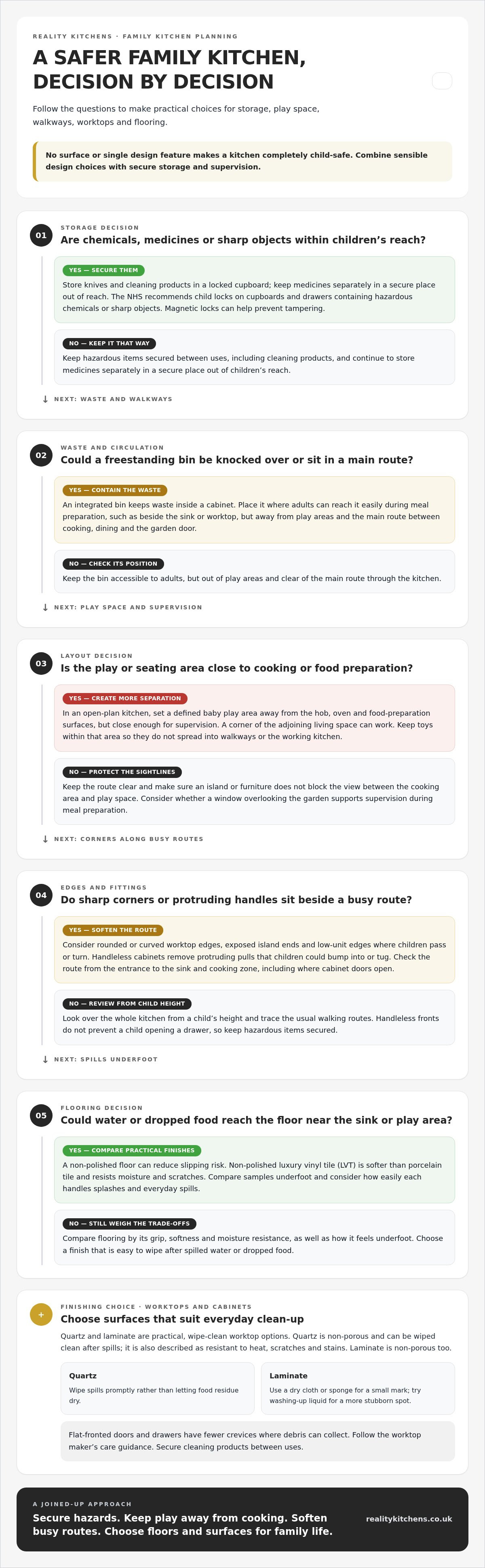
For family kitchens, quartz or laminate worktops offer practical wipe-clean surfaces. Non-polished luxury vinyl tile (LVT) is a softer, moisture-resistant flooring option. No surface makes a kitchen completely child-safe, so combine durable materials with secure storage for hazards and sensible supervision.
An integrated bin keeps waste inside a cabinet instead of in a freestanding container that a child could knock over or explore. Choose a spot adults can reach easily during meal preparation, such as beside the sink or worktop, but away from play areas. A fitted cabinet also keeps the bin out of the main route between cooking, dining and the garden door.
Quartz is non-porous and can be wiped clean after spills; it is also described as resistant to heat, scratches and stains. Laminate is another non-porous option. Remove a small mark on laminate with a dry cloth or sponge; for a more stubborn spot, use washing-up liquid. Follow the worktop maker’s care guidance and wipe spills promptly rather than letting food residue dry.
Cabinet design can make it easier to clear crumbs and sticky spills. Flat-fronted doors and drawers have fewer crevices where debris can collect. Light-coloured gloss fronts can make a bright kitchen feel open, although darker gloss may show fingerprints and marks more readily. Wipe gloss with a cloth and water, then dry it to avoid visible streaks. These details help cabinets stay presentable through busy family routines.
Choose non-toxic cleaners made with natural ingredients for everyday kitchen cleaning, and secure all cleaning products between uses. The NHS advises fitting child locks to cupboards and drawers containing hazardous chemicals and sharp objects; magnetic locks can help prevent tampering. Store knives and cleaning products in a locked cupboard, and medicines separately in a secure place out of children’s reach. The NHS recommends cupboard locks and a fridge lock to help keep kitchen hazards out of reach.
Non-polished flooring can reduce slipping risk, while LVT is softer than porcelain tile and resists moisture and scratches. Compare samples underfoot and consider how each handles splashes near the sink. A finish that is easy to wipe after spilled water or dropped food can simplify daily cleaning while maintaining a coordinated look across adjoining spaces.
2. Rounded worktop edges and handleless units
A sharp worktop corner can make an accidental collision more painful, particularly when a child moves quickly around an island. Rounded or curved edges soften that hard point, making them useful along busy routes between the sink, dining table and kitchen door. If replacing existing cabinetry or work surfaces is not feasible, practical home improvement additions and custom 3D-printed corner solutions from creative studios such as 2d6.co.uk can help cushion vulnerable edges. They don’t remove the need to supervise children, but can soften the impact of bumps. Consider exposed ends and corners as well as the main work surface.
Look at the whole kitchen from a child’s height. Worktop corners, island ends and low-unit edges may sit beside play or walking spaces. A curved end panel can create a gentler outline where children pass stools or turn towards the dining area. In a narrow kitchen, map the usual route from the entrance to the sink and cooking zone, then identify corners that project into it.
Handleless cabinets remove protruding pulls that children could bump into or tug. They also create a cleaner line, with fewer projecting details beside walkways. Choose a design that adults can open easily, then organise everyday items to avoid repeatedly reaching across children. Handleless fronts won’t prevent a child opening a drawer, so store hazardous items securely.
Flooring matters alongside rounded edges. A non-polished kitchen floor can reduce slipping risk, especially where water or dropped food reaches the floor near the sink. Combine a slip-reducing surface with rounded island corners rather than relying on either feature alone. They address different hazards: the floor affects footing, while curved edges soften potential collisions with hard surfaces.
When planning an island for cooking, consider its shape and equipment together. An induction hob avoids exposed flames, and its indicators can flash while the surface remains hot. Rounded island corners make the surrounding route less abrupt, but don’t make the cooking zone safe for unsupervised children. Keep stools away from the hob’s immediate working area and place seating where children can join family life without crowding the cook.
Before choosing a finish, compare worktop and unit samples against your kitchen plan. Trace the main walking routes, note where cabinet doors open, and check whether an island corner meets a busy passage. These steps help you choose rounded edges where they’ll be useful while preserving preparation space. A well-organised layout can pair smooth curves with practical access, creating a considered family kitchen rather than shaping the room around one safety feature.
3. Adapt open-plan and closed kitchens for baby play
For cupboards and drawers containing chemicals or sharp objects, the NHS recommends child locks; magnetic locks can help prevent tampering. Store medicines and cleaning products in secured cupboards rather than relying on a child lock as the only safeguard.
In an open-plan kitchen, create a baby play area away from the hob, oven and food-preparation surfaces, but close enough for supervision. A corner of the adjoining living space can give a baby room to play while an adult cooks or entertains. Keep toys within that defined area so they don’t spread into walkways or the working kitchen.
Plan around sightlines. Position an island or furniture so it doesn’t block the view between the cooking area and play space. If a window overlooks the garden, consider whether its position supports supervision during meal preparation. Keep the route between the sink, oven and kitchen entrance clear, especially when chairs or toys are in use.
Open-plan kitchens can give children a role without bringing them close to hot food. Placing the fridge near the entrance can let older children fetch a snack without crossing the main cooking zone. A china cupboard or children’s tableware drawer near the dining area can help them set the table away from the hob. Giving each space a clear purpose helps separate play, dining and cooking.
In a closed kitchen, use the doorway as a natural boundary and arrange the room so play stays outside the cooking area. A clear view through the doorway can help an adult keep a baby in sight. Avoid placing toys beside the entrance, where they could obstruct movement between rooms. In a smaller home, a play mat in an adjoining room can keep a baby nearby without taking up the kitchen’s working space.
UK building regulations and safety standards depend on the work being carried out. Child locks and a play zone don’t replace requirements that apply to kitchen alterations. Treat appliance placement, clear routes and supervision as practical design considerations, and account for relevant requirements when planning building work.
The cost of childproofing a kitchen depends on the changes involved: adding cupboard locks differs from altering cabinetry or changing the layout. For a redesigned kitchen, the price depends on its materials, components and scope, and is provided after a quote request. For homeowners exploring broader interior alterations alongside kitchen updates, articles from Direct Renovation Contractor Singapore provide useful examples of how working directly with renovation specialists can help manage structural improvements and project scopes.
Use colours and finishes to make zones easy to recognise. A distinct rug or play mat can mark the baby’s area, positioned away from cooking equipment. This simple visual cue helps create a welcoming kitchen for play, homework and entertaining, with each space organised for its purpose.
Use child locks on cupboards and drawers containing chemicals or sharp objects. Magnetic locks can help prevent tampering.
4. Child-sized furniture, island seating and step stools
Position appliances and preparation areas so children’s usual routes avoid hot cooking zones and sharp tools. Use the back burners and turn pan handles away from the edge; store knives out of children’s reach. Soft-close doors and drawers can reduce the risk of trapped fingers, while a child lock can restrict access to a hob.
A kitchen island can give children a place to eat, talk or help with simple food preparation. Keep activities on the side away from the hob and oven, with an adult managing hot pans and sharp utensils. A lower table attached to the island can provide a separate spot for drawing or homework, while a raised breakfast bar keeps seating farther from boiling pans.
Choose seating with the room’s walking routes in mind. Stools at an island, a peninsula breakfast bar or a dining table can all work if chairs can be pushed back without blocking traffic. Before adding stools, picture someone carrying a hot dish past a seated child. If the route feels cramped, move the seating or use a nearby table instead.
A two-tier island can give children a lower place to eat, play or do homework, while adults retain a separate preparation surface. This arrangement makes the island multi-functional without placing children beside cooking. Keep children’s activities and tableware on the lower, accessible side, and reserve the working side for meal preparation and appliances.
Step stools can help children reach the sink, but use one only where an adult can supervise. A stool beside the sink supports simple tasks, such as washing fruit, without inviting children towards the hob. Put it away after use if its position could let a child climb towards worktops or appliances.
For an island with a hob, induction is an option that avoids exposed flames. Some induction hobs include child locks and residual-heat indicators, which show that the surface remains hot after cooking. Keep pan handles turned inwards, and don’t assume an induction hob is cool simply because heating stops when the pan is removed.
Plan ovens and storage together. Triple- or quadruple-glazed oven doors are described as cooler to the touch than older styles, but adults should still manage access during cooking. Store graters and knives in a secured drawer, and place children’s plates or cups in a lower cupboard away from heat. These choices help children join family routines without entering the busiest preparation zone.
5. Choose softer, moisture-resistant kitchen flooring
Kitchen floors face spilled drinks, dropped food and constant foot traffic. Luxury vinyl tile (LVT) is softer than porcelain tile, moisture-resistant and resistant to scratching, making it a practical option for busy family spaces. A non-polished finish can also reduce slipping risk. No floor prevents every fall, so consider the surface alongside clear routes and prompt clean-ups.
Compare flooring samples where spills are most likely. Check how they feel underfoot beside the sink, dishwasher and dining table, then consider how easily you can wipe away splashes. LVT’s softer feel may be more comfortable for adults standing during meal preparation, while its moisture resistance suits areas where water may reach the floor.
Consider the whole layout, not just the material. A clear route from the kitchen entrance to the sink helps children and adults move without weaving around stools, bins or bags. Keep floor space open near the dishwasher and lower drawers, where open doors and children retrieving tableware can cause congestion. In a compact kitchen, use wall or cabinet storage to keep frequently used items off the floor.
Flooring choices also affect how the kitchen meets adjoining spaces. Check the junction between the kitchen and dining area, especially where children run between rooms or carry cups. A consistent surface can make the route feel continuous, while a clear transition can define each space. Consider how the flooring meets cabinet plinths and appliances, so crumbs and moisture don’t collect in awkward gaps.
Before choosing, walk the usual routes, note where water or food lands, and compare samples in those areas. Check how each surface looks beside worktops such as quartz, cabinets and existing flooring. Then consider cleaning: a finish that’s easy to wipe after a spill can make daily care more manageable. Follow the flooring manufacturer’s care advice to protect the finish.
Slip resistance, softness and moisture resistance address different practical needs. A non-polished floor can reduce slipping risk, while LVT offers a softer surface than porcelain tile. Consider both properties, along with the room’s traffic and cleaning routine, rather than treating one feature as a complete safety solution. Keep the floor clear and clean spills promptly to reduce slippery patches.
For a family kitchen redesign, plan flooring alongside storage and appliance positions, rather than choosing it as a final detail. Plan a family-friendly kitchen layout around clear routes, usable floor space and surfaces that suit everyday cleaning.
Reality Kitchens: Bespoke Kitchen Design
Reality Kitchens’ Bespoke Kitchen Design service can turn family-friendly priorities into a considered layout. If you’re planning a new kitchen or want to bring together practical storage, child-friendly seating and easy-care surfaces, a tailored design can help coordinate those decisions. Kitchen Components, Kitchen Appliances and Kitchen Worktops can also form part of the plan, with choices shaped around your room and how your family uses it.
Bring your everyday routines into the conversation: where children play, how you move between cooking and dining, and which areas need easier cleaning. These details help shape a welcoming kitchen that supports family life. Contact Reality Kitchens to discuss your plans and arrange a home visit for a personalised design.
Shape a kitchen that grows with your family
A family kitchen can evolve as children become more independent, so think beyond today’s routines. Consider which areas may need a different purpose later, from a child’s place at the table to surfaces used for shared meal preparation. These priorities give your child-safe kitchen design ideas a lasting direction, rather than tailoring the room to just one stage of family life.
Reality Kitchens offers Bespoke Kitchen Design, Kitchen Components and Kitchen Appliances to bring your priorities into one considered plan. A conversation about how you use the room can guide choices that suit your home and household. Start planning a kitchen that balances family life with your own sense of style.
Contact Reality Kitchens to discuss your plans, and take the next step towards a kitchen that feels ready for what comes next.
Frequently Asked Questions
What kitchen safety features are worth considering for families with young children?
Start with the risks your child can reach: secure hazardous cupboards, protect open sockets and keep sharp utensils out of reach. The NHS recommends cupboard locks for storage containing hazards, and a fridge lock can help restrict access to its contents. Then look at daily routines: clear dropped food promptly, keep bags and toys off walking routes, and make sure adults can see children from the main preparation area.
What makes a kitchen child-friendly without compromising on style?
Choose safety details that sit naturally within the room’s design, such as discreet cabinet locks and coordinated finishes. A dedicated place for children’s belongings can stop toys, cups and bags spreading across worktops. For homes in Northwich, Hartford, Weaverham, Winnington, Davenham, Knutsford, Cranage, Goostrey, Holmes Chapel, Tarporley, Helsby, Frodsham, Sandiway, Cuddington, Comerbach, Altrincham, Hale, Bowdon and Ashley, existing room proportions and family routines can guide those choices.
What are the key principles of child-safe kitchen design?
Keep hazards controlled, make adult supervision practical and give everyday activities clear places. For example, store medicines and cleaning products securely, keep play away from food preparation, and leave walking routes clear when drawers or appliances are open. The best child-safe kitchen design ideas also account for how a household changes over time, so a child’s place to eat or help can adapt as their abilities develop.
How can you make a kitchen hob, oven and hot taps safer for children?
Keep children away from active cooking and hot water, and have an adult manage appliance controls and hot cookware. Turn pan handles inwards, avoid leaving hot drinks near an edge, and don’t let a child operate a hot tap unsupervised. After cooking, treat the hob and oven as hot until they’ve cooled. Keep appliance leads and controls out of children’s reach where practical.
What safety features should a child-friendly kitchen island or breakfast bar have?
Plan the island so children can sit or take part without entering the cook’s working space. Keep the route between seating and the kitchen entrance clear, and don’t place children’s chairs beside an active hob. If the island includes cooking equipment, make the separation between cooking and seating areas clear. An adult should supervise children using the island during meal preparation.
What are practical ways to include child-friendly access without compromising kitchen safety?
Give children access to suitable everyday items, such as their cups or plates, in a low cupboard away from appliances and cleaning products. An accessible snack area can help older children make simple choices without reaching over a hob or climbing onto a worktop. Secure knives, medicines and hazardous cleaners separately, and supervise children using stools or helping with food.
What are common kitchen hazards for toddlers and how can they be prevented?
Common hazards include hot pans, sharp knives, cleaning products, open sockets, spills and drawers containing dangerous items. Reduce access by securing hazardous storage, keeping utensils out of reach and cleaning wet patches promptly. Check the floor for dropped food or toys before a toddler walks through. During cooking, keep children in a supervised area away from hot appliances and preparation surfaces.
Which childproof locks and latches work best for kitchen cupboards and drawers?
Install child locks on cupboards and drawers containing chemicals or sharp objects. Magnetic locks can help prevent tampering; keep medicines and cleaning products in secured cupboards.


