

What if the tap that saves time at breakfast also adds another appliance to maintain? Weighing the boiling water tap pros and cons means looking beyond instant tea and quicker cooking. Consider safety, electricity use, filters and whether the unit will fit beneath your sink.
The appeal is easy to understand: hot water is ready when you need it, without filling and waiting for a kettle. But a kettle may suit your household better if you use it occasionally, have young children around or prefer to avoid extra upkeep. The right choice depends on how your kitchen works, not just how convenient a tap sounds.
This guide compares a boiling-water tap with a kettle through everyday routines, practical trade-offs and the space and planning involved. You’ll find guidance on sink position, under-sink storage, safety and maintenance, so you can judge whether a tap fits your home and any wider kitchen plans.
Key Takeaways
- The boiling water tap pros and cons depend on your daily routine, sink area and willingness to plan for equipment and upkeep.
- Compare what different systems dispense and how they work. Functions, controls and installation needs can vary.
- Consider scald risks alongside model-specific safeguards, and make safety part of your household decision.
- Compare convenience, worktop space, maintenance and energy information without assuming one option always costs less.
- Map your kitchen routines, sink position and under-sink space before comparing specifications or planning a wider redesign.
Boiling water tap pros and cons: what does one actually do?
A boiling-water tap is a kitchen tap system that dispenses near-boiling water when needed. It usually works with a unit fitted beneath the sink, where water is heated or held ready for dispensing. The arrangement varies: the Instant hot water dispenser overview describes systems with and without a storage tank. When comparing products, use each system’s own specifications to understand how it works.
These systems are designed to sit alongside everyday kitchen water, not necessarily to replace every use for a kettle. Functions, controls and safeguards differ, as do installation requirements and the space needed below the sink. Some designs include filtered water or other dispensing options, but these features aren’t universal. Check the details for the specific system you’re considering.
To weigh the boiling water tap pros and cons for your home, look beyond the promise of speed. Consider how often you need hot water, whether the controls and safety features suit your household, and what energy use and maintenance the system involves. Its fit with your sink area and under-sink storage matters too.
How a boiling-water tap works in everyday use
Instead of filling a kettle, you use the tap’s control to dispense near-boiling water into a mug, pan or other suitable vessel. The tap connects to a heating or hot-water storage unit, commonly positioned in the cupboard beneath the sink. The way you activate it, dispense water and use its safeguards depends on the system, so don’t assume every tap works in the same way.
Before choosing a system, check its controls, functions, installation needs and any included filtration. This helps you understand the space it requires and what using and maintaining it will involve.
Boiling-water tap versus kettle: the basic difference
A tap can provide hot water without the separate steps of filling, boiling and pouring a kettle. That may matter if you regularly prepare several hot drinks or use hot water for cooking. If you only boil water occasionally, or often need to heat a larger volume at once, a kettle may remain more convenient. Your habits, rather than the appliance alone, should guide the choice.
Instant access doesn’t prove that a tap will use less energy or cost less to run than a kettle. Usage, system design and maintenance all affect the comparison. Look for current, product-specific information instead of treating convenience as a measure of efficiency.
The advantages of a boiling water tap: speed, convenience and a clear worktop
The main advantage is simple: near-boiling water is available at the sink without waiting for a kettle. If you make tea or coffee throughout the day, or often need hot water to prepare ingredients, removing a few steps from those routines can be useful. The benefit is less noticeable if you only boil water now and then.
A boiling-water tap earns its place through the routines it simplifies, not through a universal promise of savings. That distinction matters when weighing the boiling water tap pros and cons. Convenience depends on how often you use hot water, while energy use and running costs need to be judged separately.
When instant hot water makes daily tasks easier
For people who regularly make hot drinks, on-demand dispensing can make it simpler to fill a mug when needed. It may also help with selected cooking tasks, such as preparing hot water for a pan or rehydrating ingredients. It won’t make every kitchen job quicker, and water still needs to be dispensed safely into a suitable vessel. BBC Good Food’s tested and reviewed guide offers a practical perspective on comparing dispenser features.
Think about your busiest moments. A household making successive drinks at breakfast may appreciate having water ready more than one that boils a kettle occasionally. For larger volumes, or tasks where a kettle already fits your routine, the tap may add little convenience.
Can a boiling-water tap make the kitchen feel less cluttered?
Replacing a kettle can free up worktop space and leave one less appliance on display. This may be welcome in a compact kitchen where the kettle competes with preparation space. But the tap still occupies part of the sink area, and its associated equipment needs a suitable place beneath the sink. The visual gain depends on the whole layout, not just the tap.
Consider how the tap would sit alongside your sink, draining area and other appliances. A well-planned kitchen brings these choices together, keeping the worktop practical as well as uncluttered. If you’re considering a wider update, bespoke kitchen design can help coordinate sink position, worktops and appliance planning around your space and household routines.
The disadvantages of boiling water taps: safety, upkeep and running costs
The convenience comes with practical responsibilities. A boiling-water tap needs compatible plumbing, a suitable power supply and room for its heating or storage unit. It may not suit every sink cupboard or existing kitchen layout, and the tap itself takes up space at the sink. Before choosing one, consider the installation requirements and whether the equipment will use storage you rely on.
There’s upkeep to factor in too. Some systems use filters that need replacing, while others have different care requirements. Electricity use can include keeping water ready between uses, so frequent dispensing doesn’t automatically mean lower overall costs. Running costs depend on the system’s specifications and how your household uses it. Compare current energy information and the filter or maintenance guidance for the specific system rather than judging by convenience alone.
Safety and suitability for households with children
Near-boiling water can cause serious scalds, so careful use matters, particularly in a busy kitchen with children. Controls and safeguards vary by model. Check how the tap is activated and which features are designed to reduce accidental dispensing. Consider who can reach it, where it sits in relation to play or preparation areas, and how your household supervises children. No feature removes the need for sensible handling.
Read the instructions for the specific system to understand how it dispenses water and which safeguards are built in. Follow the manufacturer’s guidance and consider whether the tap’s position and controls suit everyone who uses your kitchen. These details matter especially in a household where children may be nearby during busy routines.
Installation, maintenance and ongoing use
Look at the full installation requirements, not just the tap’s appearance. The under-sink unit needs suitable space, and the system’s plumbing and electrical requirements must work with the kitchen. In a renovation, planning the unit alongside the sink, cupboards and other appliances can help avoid an awkward fit later.
Then check what ownership involves. If the system includes a filter, find out how replacement works and what the manufacturer recommends for routine care. Compare the stated energy use and maintenance needs with how often you expect to use the tap. For some households, the convenience may justify these extra considerations. For others, a kettle’s simpler setup may feel like the better fit.
Boiling-water tap or kettle: how to compare the options for your home
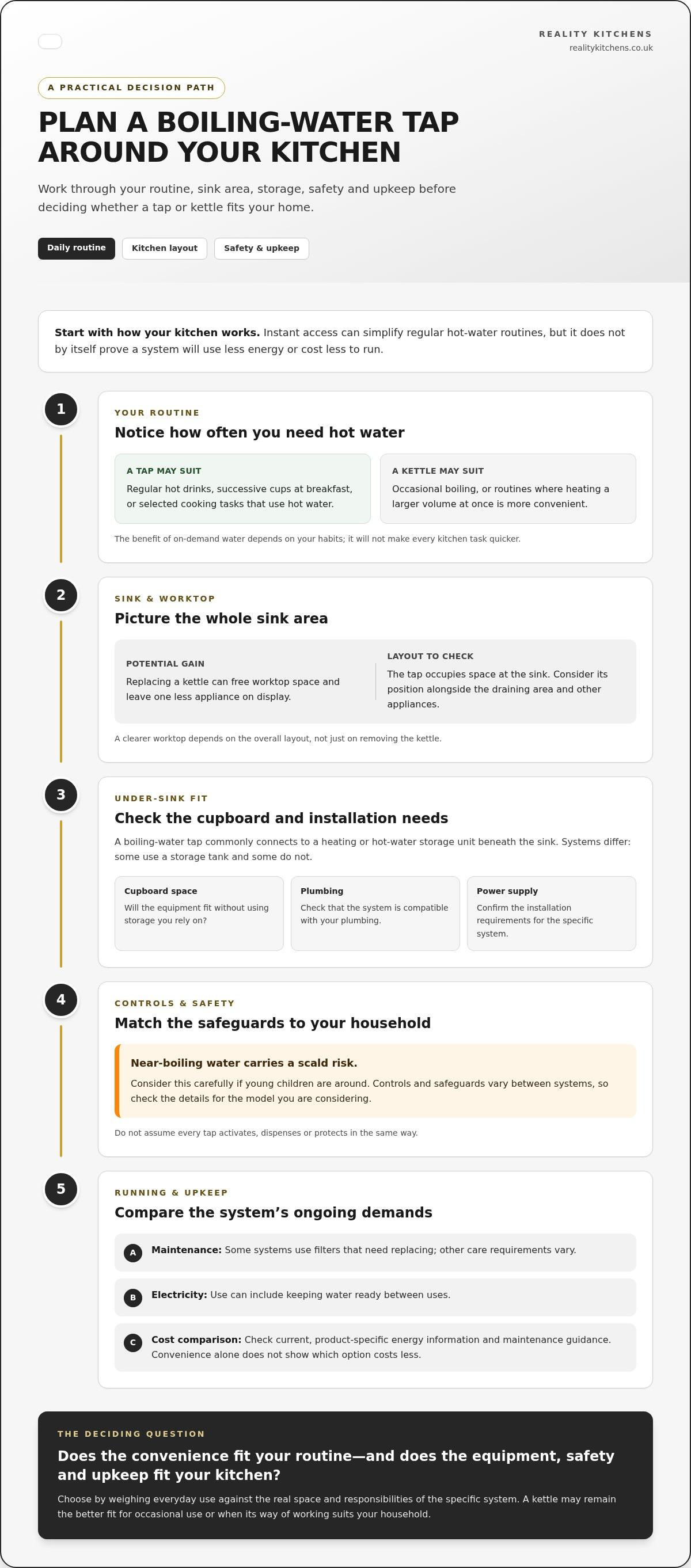
The right choice depends on how often you use hot water, who uses the kitchen and how much space you have. This comparison can help you weigh the boiling water tap pros and cons against your routines, without assuming one option is automatically cheaper or more efficient.
| Consideration | Boiling-water tap | Kettle |
|---|---|---|
| Convenience | Dispenses hot water at the sink on demand, useful for frequent drinks or cooking tasks. | Needs filling, boiling and pouring, but may suit occasional use. |
| Counter space | May remove a kettle from the worktop, but uses sink space and needs room for associated equipment. | Occupies worktop space and can be moved or stored when not in use. |
| Safety | Near-boiling water needs careful handling. Controls and safeguards vary by system. | Hot water and the kettle itself can also pose a scald risk. Placement and careful use matter. |
| Maintenance | Care depends on the system and may include filter replacement or other specified upkeep. | Requires routine cleaning and care according to the appliance instructions. |
| Energy information | Check the system’s stated energy use, including any standby use. | Energy use depends on how much water you boil and how often. |
Which households are most likely to value a boiling-water tap?
If several people make hot drinks throughout the day, or hot water is a regular part of your cooking routine, on-demand access may feel worthwhile. Consider whether everyone who’ll use it can do so safely, whether the sink area works for dispensing, and whether you’re comfortable with the system’s care requirements. Frequent use may make the convenience more noticeable, but doesn’t by itself prove lower running costs.
When a kettle may remain the more practical choice
A kettle can be a sensible fit if you only need hot water occasionally, prefer familiar operation or want an appliance that’s easy to move or replace. It also avoids adding a dedicated unit beneath the sink. If you’re planning a kitchen update, weigh these preferences alongside sink position, cupboard space and appliance layout. A boiling-water tap makes more sense when its everyday usefulness justifies the extra planning.
For a wider kitchen update, consider how your household routines, sink area and appliance choices fit together. Explore kitchen design for an overview of how bespoke planning can bring those decisions into one layout.
Plan a boiling-water tap around your kitchen, not just the appliance
A tap can be convenient in daily use, but it also needs to work with the room around it. Before choosing a system, consider where you make drinks, prepare food and wash up. Then check how the tap and its associated equipment would fit with the sink, cupboards and worktop. This turns the boiling water tap pros and cons into a practical kitchen-planning decision, rather than a choice based on the appliance alone.
What to consider before including a boiling-water tap
Use this short sequence to see whether the idea suits your layout:
- Map your routines. Notice where you make hot drinks and carry out cooking tasks. Is the sink a convenient point for both?
- Review the sink area. Consider tap position, space for filling vessels and how the sink is used for washing up.
- Assess equipment space. Check whether the associated unit can fit beneath the sink, with practical access and in line with the system’s requirements.
- Compare specifications. Review functions, controls, installation needs, safety features and maintenance guidance for the specific system.
Worktop and sink choices also shape how comfortable the arrangement feels. A tap placed too close to a busy preparation area may interrupt how you use the surface, while careful positioning can help drink-making and food preparation flow. Consider finishes and materials as part of the overall scheme, rather than treating the tap as a last-minute addition. For more on fitting appliances into a coordinated layout, read the integrated kitchen appliances guide.
Make the appliance decision part of a bespoke kitchen plan
If you’re updating your kitchen, plan appliances alongside storage, worktops and sink position. A home visit allows the design to respond to the actual space and your household’s routines, including how you move between cooking, washing up and making drinks. Explore bespoke kitchen design in Northwich to see how a tailored kitchen can be planned around your home.
A boiling-water tap may be a useful part of that plan if its convenience, upkeep and space requirements suit your home. If you’re considering a wider redesign, Reality Kitchens’ bespoke design service brings your kitchen choices together as part of a personalised design.
Choose the option that fits your kitchen and routine
The boiling water tap pros and cons come down to more than speed. Consider how often your household needs hot water, whether the system’s safety features and upkeep suit your needs, and whether there’s room for its equipment beneath the sink. A kettle may remain the simpler choice for occasional use, while a tap could make frequent routines more convenient.
If you’re planning a wider kitchen update, consider the appliance alongside sink position, worktops and available storage. Reality Kitchens’ personalised home visits help shape a design around your actual space and household routines. Kitchen appliances, worktops and components are supplied as part of bespoke projects, with trusted installers supporting the wider kitchen project.
Plan your bespoke kitchen with Reality Kitchens, with a home visit tailored to your space and routines in Northwich, Hartford, Weaverham, Winnington, Davenham, Knutsford, Cranage, Goostrey, Holmes Chapel, Tarporley, Helsby, Frodsham, Sandiway, Cuddington, Comerbach, Altrincham, Hale, Bowdon and Ashley.
Frequently Asked Questions
Are boiling water taps worth it?
They may be worthwhile if your household regularly uses hot water and values having it ready at the sink. If you only boil a kettle occasionally, the convenience may be less compelling. Weigh the boiling water tap pros and cons against your routine, including the system’s installation requirements, safety features and maintenance. Check product-specific energy information too, rather than assuming the tap will save money or suit every household.
Are boiling water taps cheaper to run than kettles?
There’s no single answer that applies to every system and household. A tap’s energy use depends on its design, standby behaviour and how often you dispense water. A kettle’s use depends partly on how much water you boil each time. Compare current manufacturer information for the tap with your own habits, including how often you boil the kettle. Treat broad savings claims cautiously unless their assumptions are clear.
Are boiling water taps safe to use?
They dispense very hot water, so there is a scald risk and careful handling is essential. Controls and safety features differ between models, and no safeguard removes the need to use the tap responsibly. Read the instructions for the specific system and consider who uses your kitchen, especially if children are present. The tap’s position and your household’s everyday behaviour should both inform your decision.
Do boiling water taps need filters?
Some systems use filters, but this isn’t a universal feature or requirement. Check the specifications for the tap you’re considering to see whether a filter is included or required, and read the manufacturer’s guidance on replacement and care. Filter upkeep is one part of ownership to compare alongside equipment space, other maintenance and how often your household will use the tap. Don’t assume every system has the same filtration function or schedule.
Can a boiling water tap replace a kettle?
It can handle many everyday kettle tasks, such as preparing hot drinks, if its functions suit your needs. It may not replace every use, and you might prefer to keep a kettle for flexibility or familiar operation. Consider how often you need hot water, the amount you typically use and the system’s maintenance requirements. The best choice depends on your routine, rather than a general rule that one appliance should replace the other.
Do boiling water taps take up much space?
The tap is fitted at the sink, and its associated equipment may need space in a nearby cupboard or under the sink. Exact requirements vary, so use the product specifications when planning. Allow for access to the equipment as well as the storage you use day to day, and consider future maintenance. Reviewing the sink area and cupboard layout can help show whether the system will fit comfortably alongside other kitchen components.
Can you include a boiling water tap in a new kitchen design?
Yes, it can be considered as part of the wider kitchen plan. Its position should work with the sink, worktop and food preparation areas, while the associated equipment must fit according to the product requirements. Reality Kitchens visits homeowners at home to understand their space and routines, then plans bespoke kitchens for Northwich, Hartford, Weaverham, Winnington, Davenham, Knutsford, Cranage, Goostrey, Holmes Chapel, Tarporley, Helsby, Frodsham, Sandiway, Cuddington, Comerbach, Altrincham, Hale, Bowdon and Ashley.


